毕
Character Story & Explanation
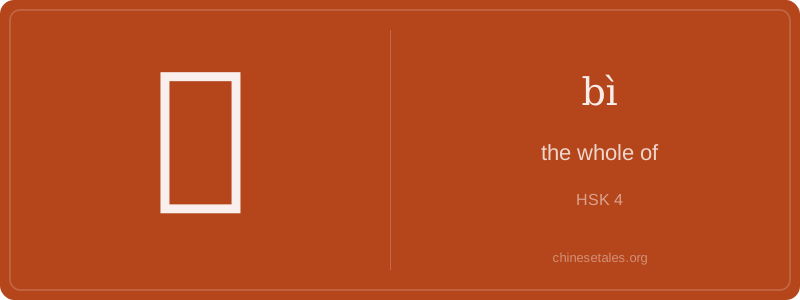
Carved over 3,000 years ago on oracle bones, 毕 began as a pictograph showing an arrow (矢) lodged firmly in a target — not just hitting it, but *embedded to the fletching*, leaving no part protruding. The earliest form combined 矢 (arrow) + 十 (a crossbar symbolizing the target’s center), evolving into bronze script where the arrowhead merged with a horizontal stroke. By the Small Seal Script, the top simplified to two parallel lines (like 比), and the bottom became 匚 (a container shape), visually echoing ‘enclosure’ and ‘finality’. Crucially, the modern six-stroke form retains this logic: the radical 比 (bǐ, ‘to compare’) hints at ‘measuring up to completion’, while the lower component 匚 (fāng) suggests containment — the whole thing ‘contained within its end’.
By the Warring States period, 毕 shifted from literal ‘arrow fully embedded’ to abstract ‘completion’ — appearing in the *Zuo Zhuan* describing military campaigns ‘毕矣’ (bì yǐ — ‘now concluded’). Its philosophical weight deepened in Daoist texts like the *Zhuangzi*, where ‘毕天地之大美’ (bì tiān dì zhī dà měi) means ‘to fully realize heaven-and-earth’s grand beauty’ — not just ‘finish’, but ‘fulfill to essence’. Even today, that ancient image lingers: when you write 毕, you’re drawing a boundary line — the last stroke is the seal that says, ‘nothing remains outside.’
Imagine you’re at a graduation ceremony in Beijing — caps fly, parents beam, and the principal declares: ‘同学们,你们的学业已毕!’ (tóng xué men, nǐ men de xué yè yǐ bì!). That little 毕 isn’t just ‘done’ — it’s the quiet, weighty *closure* of something complete and irrevocable, like sealing a scroll or lowering the final curtain. In Chinese, 毕 carries gravitas: it signals full completion, often with a ceremonial or formal tone — not casual ‘finished eating’ (that’s 吃完了), but ‘the project is concluded’, ‘the investigation is concluded’, or ‘life has reached its end’. It’s rarely used alone; instead, it appears in compounds or with auxiliary words like 已 (already), 尽 (exhaustively), or 业 (studies).
Grammatically, 毕 almost never stands solo as a verb. You’ll see it in fixed phrases: 毕业 (graduate), 毕竟 (after all — literally ‘after reaching the end’), or in classical-style constructions like ‘毕其功于一役’ (bì qí gōng yú yī yì — ‘achieve the entire result in one campaign’). Learners often mistakenly use 毕 where they mean 已经 or 完了 — but 毕 feels like a seal pressed in red ink: official, irreversible, and slightly solemn.
Culturally, 毕 echoes Confucian reverence for closure and ritual fulfillment — think of finishing rites, ancestral records, or scholarly examinations. Its formality means it’s rare in texting or slang (you won’t see ‘我毕了’ for ‘I’m done!’). And watch out: while 毕业 is HSK 4, using 毕 alone in speech sounds archaic or poetic — unless you’re quoting Zhuangzi or signing a legal document!