登
Character Story & Explanation
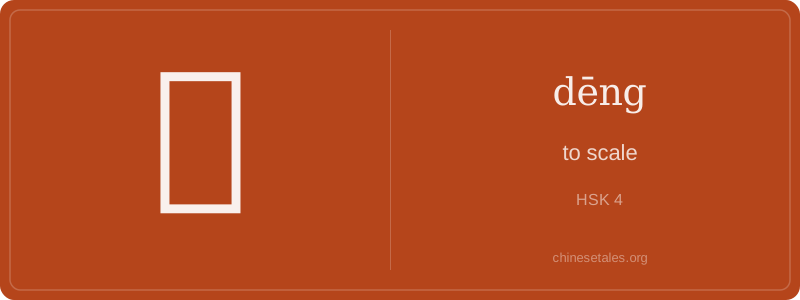
The earliest form of 登 appears in bronze inscriptions (c. 1000 BCE) as a vivid pictograph: two feet (the radical 癶, pronounced bō, meaning ‘to walk with effort’) stepping up a series of ascending lines — representing steps or a steep slope — topped by a vessel (豆, dòu, an ancient ritual food container). Over time, the vessel evolved into the top component 亠 + 冖 + 豆 (simplified now to the upper part of modern 登), while the feet remained firmly rooted below. The 12 strokes map this journey: six for the ‘stepping feet’ radical, six for the ‘ritual ascent’ above — a perfect visual metaphor for effort meeting ceremony.
This origin explains why 登 never meant mere physical climbing — it was always about *ritual elevation*: presenting offerings on altars, entering ancestral temples, or ascending the imperial dais. In the Classic of Poetry, 登 is used in ‘登彼虚矣’ (‘I ascend that mound’) — not just geographically, but spiritually. By the Han dynasty, it extended to scholarly achievement (登第, ‘pass the exam’) and political office (登用, ‘appoint to office’). The character’s shape — feet striding upward toward a sacred vessel — remains a silent reminder: every 登 is both action and intention.
Imagine you’re standing at the base of Mount Tai at dawn — mist curls around ancient stone steps, and pilgrims in simple clothes ascend slowly, deliberately, each footfall echoing centuries of reverence. That’s the *feel* of 登 (dēng): not just ‘to climb’ like scrambling up a ladder, but to scale with purpose, dignity, and ritual weight. It implies upward movement toward something significant — a peak, a stage, a rank, or even a digital platform. Unlike 爬 (pá), which is casual or physical (‘crawl/climb’), 登 carries gravitas: you 登山 (dēng shān) a sacred mountain, 登台 (dēng tái) a stage for performance, or 登录 (dēng lù) a website — as if stepping onto hallowed ground.
Grammatically, 登 is almost always transitive and pairs with nouns indicating the target: 登 + [place/object]. It rarely stands alone — you won’t say ‘I dēng’; you’ll say ‘I dēng the Great Wall’. It can also be used in compound verbs like 登上 (dēng shàng, ‘to ascend onto’) or 登临 (dēng lín, literary ‘to stand atop and survey’). A common learner mistake? Using 登 where 爬 or 上 (shàng) fits better — e.g., saying ‘登楼梯’ instead of ‘上楼梯’ (climbing stairs is routine, not ceremonial).
Culturally, 登 evokes imperial legitimacy: emperors 登基 (dēng jī, ‘ascend the throne’), and scholars 登科 (dēng kē, ‘pass the imperial exams’) — both metaphors for attaining highest status. Even today, 登 is preferred in formal, written, or aspirational contexts. In spoken Mandarin, people often default to 上 for everyday ascent — but mastering 登 unlocks nuance, elegance, and historical resonance.