省
Character Story & Explanation
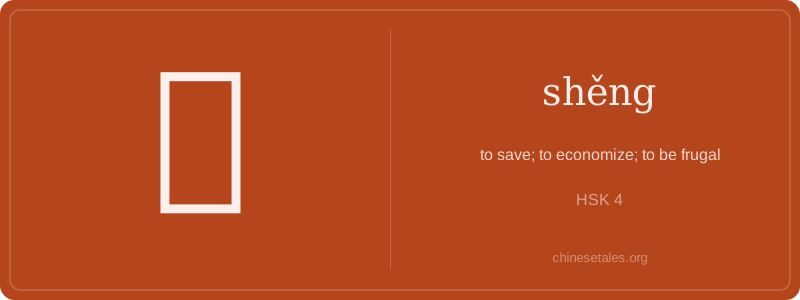
The earliest form of 省 appears in bronze inscriptions as a stylized eye (目) above a simplified 'little person' (小), suggesting someone *looking inward* — literally 'eye + small' — to observe their own actions closely. Over centuries, the 'small' evolved into 少 (shǎo, 'few'), which now sits neatly atop 目 in the modern character. The nine strokes flow deliberately: first the eye radical (five strokes), then the upper 少 (four strokes), visually reinforcing the idea of focused observation — not just seeing outward, but scanning one’s own behavior for excess.
This introspective origin explains why 省 split into two pronunciations: xǐng (as in 反省 fǎnxǐng, 'to reflect') preserves the original 'self-examination' sense, while shěng emerged later as a semantic extension — if you examine your habits carefully, you naturally cut waste. Mencius (3rd c. BCE) used 省 in the phrase '吾日三省吾身' ('I examine myself three times daily'), anchoring its moral gravity. By the Tang dynasty, shěng had fully crystallized as 'to economize', linking inner discipline to outward thrift — a beautiful linguistic echo of Confucian ethics made visible in ink.
Imagine your friend Li Wei is planning a trip to Xi’an. She’s checking train tickets, comparing hotel prices, and double-checking her budget app — all while muttering, 'I need to 省 money this month!' That little word 省 (shěng) isn’t just 'save' like clicking 'apply coupon' — it’s an active, intentional *restraint*: trimming expenses, cutting corners thoughtfully, even skipping dessert to fund something meaningful. It implies awareness, discipline, and quiet resolve — not scarcity, but wise allocation.
Grammatically, 省 is almost always a verb (not an adjective), and it takes direct objects: you 省 time, 省钱, 省精力. You *don’t* say 'I am very 省' — that’s ungrammatical. Instead, use it in transitive constructions: 'She 省了五十块' (She saved 50 RMB). Note the tone — shěng, *not* xǐng — unless you’re talking about 'self-reflection' (a completely different meaning tied to classical Confucian practice). Learners often mispronounce or misuse it as a noun ('a saving'), but it’s strictly action-oriented.
Culturally, 省 carries Confucian weight: frugality isn’t stinginess — it’s moral clarity. In modern life, it shows up everywhere: ads boasting '省电模式' (energy-saving mode), parents saying '省着点花' (spend sparingly), or apps labeled '省钱神器' (money-saving magic tool). A common mistake? Confusing it with 简 (jiǎn, 'simplify') — but 省 is about *reducing quantity*, while 简 is about *reducing complexity*. One saves yuan; the other saves steps.