众
Character Story & Explanation
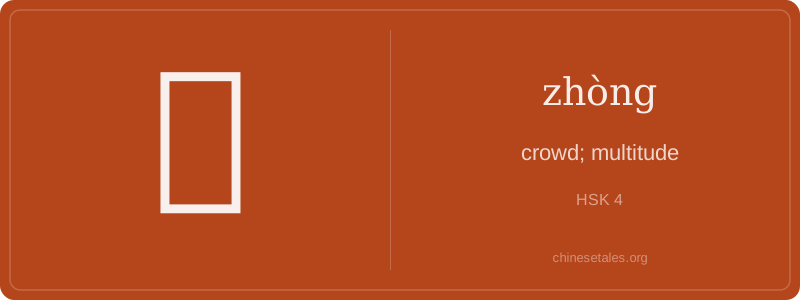
The earliest form of 众 in oracle bone script (c. 1200 BCE) was a striking triple-person pictograph: three 人 (rén, 'person') characters stacked vertically or arranged in a triangular cluster — no radical, no abstraction, just pure visual multiplication. This wasn’t abstract math; it was a snapshot of a gathering — three individuals standing close, implying group formation, shared purpose, or collective witness. As bronze inscriptions emerged, the forms tightened: the top person shrank into a simplified head-and-arms shape, the middle became more stylized, and the bottom solidified into the full 人 we recognize today — evolving into the modern 众 with its clean, balanced triple-人 structure (though now written as two small 人 above one large 人, preserving the triadic essence).
This triad wasn’t arbitrary: in ancient Chinese cosmology, three symbolized completeness and vitality (think 三才 — Heaven, Earth, Humanity). So 众 didn’t just mean 'three people' — it meant 'enough people to constitute a meaningful social unit.' By the Warring States period, it appeared in texts like the *Analects* (e.g., 众人皆醉我独醒 — 'All others are drunk; I alone am sober'), where it carried moral weight — the 'crowd' as both societal norm and potential source of conformity. Its visual persistence across 3,000 years is a testament to how deeply Chinese thought links human multiplicity with social meaning.
At its heart, 众 (zhòng) isn’t just ‘crowd’ — it’s the visual and conceptual weight of *many people together*, carrying a subtle sense of shared presence, collective energy, or even social expectation. Unlike generic words for 'many' like 多 (duō), 众 implies human beings in proximity: not just quantity, but co-presence. You’ll rarely see it standalone — it almost always appears in compounds (like 众人 or 众生) or classical-style expressions. In modern Mandarin, it’s more literary or formal than everyday口语; saying 'a crowd gathered' would usually be 一群人 (yì qún rén), but 众人围观 (zhòng rén wéi guān) instantly adds gravitas, like a scene from a historical drama.
Grammatically, 众 functions as a noun ('the masses', 'everyone') or an attributive prefix meaning 'all' or 'public' — think 众目睽睽 (zhòng mù kuí kuí, 'under everyone’s watchful eyes'). Crucially, it’s never used numerically (you can’t say *三众*); it’s inherently plural and non-quantifiable. Learners often mistakenly treat it like a countable noun or confuse it with 们 (men) — but 们 only attaches to pronouns (我们, 他们), while 众 is a standalone lexical root that *evokes* plurality through imagery, not grammar.
Culturally, 众 echoes Confucian ideals of communal harmony and collective responsibility — it’s the 'we' before the 'I'. It appears in foundational phrases like 众志成城 (zhòng zhì chéng chéng, 'united will builds a fortress'), reinforcing that strength lies in unity. A common pitfall? Overusing it in casual speech — sounding oddly archaic or bureaucratic. Reserve it for writing, speeches, idioms, or when you want deliberate solemnity. Also, note its tone: zhòng (fourth tone, falling), not zhōng (first tone) — mispronouncing it as 'zhōng' might make listeners think of 中 (zhōng, 'middle') instead!