研
Character Story & Explanation
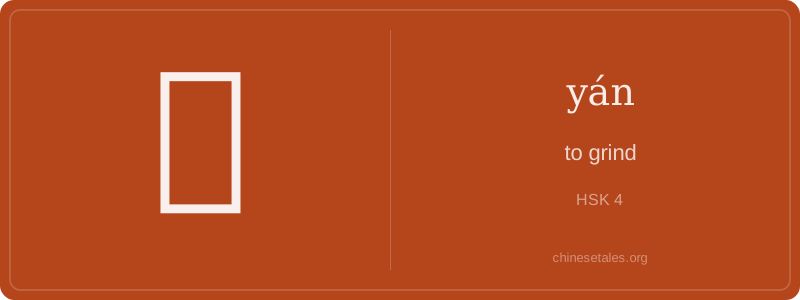
The earliest form of 研 appears in bronze inscriptions as a combination of 石 (shí, 'stone') on the left and 开 (kāi, 'to open/crack') or an early variant of 幵 (a double 'gate' shape) on the right—depicting a stone mortar with a pestle pressing down to crush material inside. Over centuries, the right side simplified and stylized: the two horizontal strokes and crossing diagonal of 幵 gradually morphed into the modern 彦 (yàn) component—not for sound, but as a phonetic loan that stabilized the pronunciation yán. The nine strokes we write today preserve that ancient tension: solid stone meeting forceful pressure.
By the Han dynasty, 研 had expanded beyond literal grinding to mean 'to examine closely'—as in the phrase 研精覃思 (yán jīng tán sī, 'to refine one’s intellect and ponder deeply'), used in texts like the *Book of Han*. Its visual duality remains brilliant: the radical 石 grounds it in the physical world (stone, hardness, substance), while the right side hints at intellectual 'opening'—not smashing, but patiently breaking down complexity until clarity emerges, grain by grain.
At its heart, 研 isn’t just 'to grind'—it’s the physical, patient act of reducing something hard (like stone or inkstone) into fine, usable powder. That tactile, laborious image anchors all its modern meanings: research (研), analysis (研读), and even deep discussion (研讨). In Chinese thinking, knowledge isn’t downloaded—it’s *ground out*, stroke by careful stroke. You don’t ‘do’ research; you *yán* it—implying effort, refinement, and transformation.
Grammatically, 研 is almost never used alone in speech—it’s a classic component of compound verbs or nouns. You’ll say 研究 (yánjiū, 'to research'), not just 研. It rarely takes aspect particles like 了 or 过 directly—instead, you’d say 他正在研究 (tā zhèngzài yánjiū, 'He is researching'). Learners often mistakenly try to use 研 as a standalone verb ('I研 this problem')—a red flag that instantly marks non-native speech.
Culturally, 研 evokes the scholar’s inkstone: a smooth black slab where inksticks were ground with water to make ink for calligraphy and examination essays. This wasn’t busywork—it was ritual preparation of the mind. Even today, when students say 我在研读古文 (wǒ zài yándú gǔwén, 'I’m closely studying classical texts'), they’re invoking that same meditative, grinding discipline—not speed-reading, but *grinding meaning from dense language*.