破
Character Story & Explanation
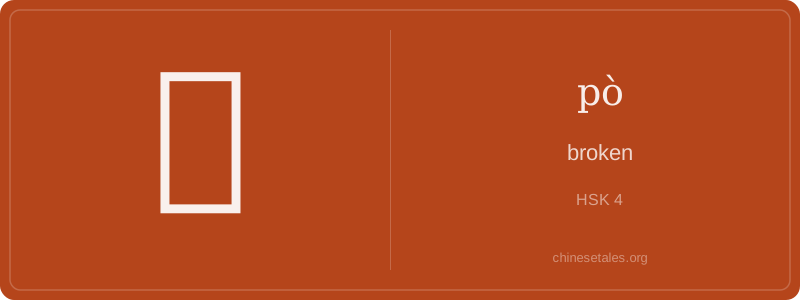
The earliest form of 破 appears in bronze inscriptions around 1000 BCE: a stone (石) on the left, and on the right, a stylized figure with bound hands and a bent back—originally 奚 (xī), depicting a captured servant. Together, they showed *breaking a person’s will using stone tools*, or perhaps smashing a stone barrier with human effort. Over centuries, the bound figure simplified: the top became 亻 (rén, 'person'), the middle evolved into 又 (yòu, 'again/hand'), and the bottom stabilized as the 'servant' component—eventually crystallizing into today’s 奚. The 10 strokes now flow with purpose: first the solid 石 (5 strokes), then the dynamic, multi-layered 奚 (5 strokes) leaning forward like a body thrusting against resistance.
This visual tension mirrors its semantic journey. In the *Zuo Zhuan*, 破 describes armies breaching city walls; by Tang poetry, it’s used metaphorically—Li Bai wrote of ‘breaking’ moonlight with wine cups (破月光). The character never lost its sense of *intentional force*, whether physical or philosophical. Even today, when we say 破题 (pò tí, 'break the topic'), we mean cutting straight to the heart of an essay—not skirting around it. Its shape still whispers: *stone meets will—and something gives way.*
At its core, 破 (pò) isn’t just 'broken' like a dropped teacup—it’s about *forceful disruption*: tearing through, shattering barriers, or breaking open something sealed. Think of it as the verb you’d use for bursting a dam, cracking a code, or demolishing a stale tradition—not just passive damage. The radical 石 (shí, 'stone') hints at hardness and resistance; the right side 奚 (xī) originally evoked a servant or captive—so imagine stone + subjugation: *something rigid being forcibly undone*. That’s why 破 always implies agency and impact.
Grammatically, 破 is versatile but precise: it can be transitive ('He broke the vase'), intransitive ('The dam broke'), or even abstract ('break a record', 'break silence'). Crucially, it’s rarely used for *reversible* states—no 'broken pencil' (that’s 断 duàn) or 'broken heart' (that’s 伤 shāng). Learners often overuse it for everyday malfunctions (e.g., 'my phone is broken' → 手机坏了 shǒujī huài le, not *破了*), because 破 carries weight—like announcing a rupture in reality itself.
Culturally, 破 appears in pivotal phrases like 破釜沉舟 (pò fǔ chén zhōu, 'smash the cooking pots and sink the boats')—a legendary military tactic symbolizing irrevocable commitment. It’s also central to Daoist and Chan Buddhist thought: 破执 (pò zhí, 'break attachment') means shattering illusion. Mistake it for passive decay, and you’ll miss its energetic, almost heroic connotation: this isn’t wreckage—it’s liberation through rupture.