童
Character Story & Explanation
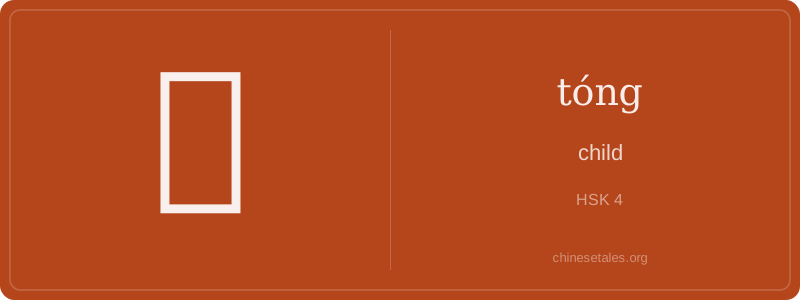
The earliest form of 立 appears in oracle bone inscriptions as a stylized figure: a kneeling person with exaggerated head and arms raised — possibly depicting a servant or ritual attendant in submission. By the bronze script era, the top evolved into 重 (zhòng, 'heavy') or simplified into 里 (lǐ), while the bottom solidified into 立 (lì, 'to stand'), anchoring the character visually and semantically in upright presence. Over centuries, strokes streamlined: the top condensed into 里 (now a phonetic hint), and the bottom remained 立 — turning what began as a gesture of humility into a symbol of youthful vitality standing firm.
This evolution mirrors how the meaning deepened: from 'servant youth' (in early Zhou texts, where 童 referred specifically to adolescent male servants) to the broader, gentler sense of 'child' by the Han dynasty. The Classic of Poetry (Shījīng) uses 童 in lines like '童子佩觿' (tóngzǐ pèi xī) — 'the boy wears a jade pendant' — signaling both youth and nascent social responsibility. Crucially, the 立 radical isn’t decorative: it signals the character’s core idea — a child not as passive, but as *standing ready*: learning, observing, poised on the threshold of personhood.
At its heart, 童 (tóng) isn’t just a neutral word for 'child' — it carries a gentle, almost poetic weight: think of childhood as a state of unselfconscious purity, not just biological age. Unlike 孩子 (háizi), which is warm and colloquial ('my kid'), 童 feels more literary or formal — you’ll see it in phrases like 童年 (tóngnián, 'childhood') or 童话 (tónghuà, 'fairy tale'), where it evokes innocence, imagination, and a touch of nostalgia. It’s rarely used alone to address a child directly (you wouldn’t say *'tóng!'* like 'hey, kid!'); instead, it thrives in compounds and abstract concepts.
Grammatically, 童 functions almost exclusively as a noun or noun modifier — never a verb or adjective — and almost never appears without a second character. Learners sometimes overextend it, trying to say 'a child' as *yī gè tóng*, but that’s unnatural; use 孩子 or 小孩 instead. When paired with measure words, it’s always in compounds: 一名童工 (yī míng tónggōng, 'one child laborer'), where 名 (míng) is the formal classifier for people in official or legal contexts.
Culturally, 童 reflects Confucian ideals of childhood as a time of potential and moral receptivity — hence 童蒙 (tóngméng, 'childlike ignorance' in classical texts, later meaning 'early education'). A common pitfall? Assuming 童 = 'young person' broadly — but it excludes teens and young adults (that’s 青少年 qīngshàonián). Also, while 童 can appear in respectful terms like 童叟 (tóngsǒu, 'child and elder'), it never implies immaturity in adults — unlike English 'childish', which has negative connotations. Here, 童 is inherently dignified.