竞
Character Story & Explanation
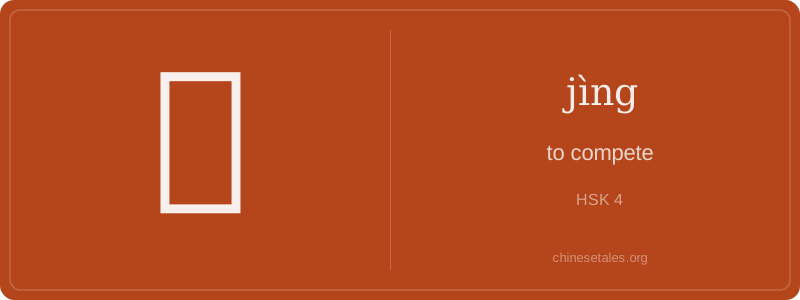
The earliest form of 竞 appears in bronze inscriptions as two identical figures standing side-by-side, both facing forward, with arms raised — a vivid depiction of two people *matching pace*, running neck-and-neck. Over centuries, the double figures simplified into two ‘yǒu’ (尤) shapes stacked vertically, then further stylized: the top became two ‘shàng’ (丄)-like strokes, the bottom evolved into ‘jǐng’ (井) — but crucially, the radical 立 (lì, ‘to stand’) remained anchored at the bottom, grounding the whole idea in upright, intentional presence. By the Han dynasty, the modern shape had crystallized: 立 + two mirrored halves suggesting symmetry, tension, and parallel effort.
This visual duality — two forms mirroring each other atop a stable base — perfectly mirrors its semantic journey. In the Classic of Poetry (Shījīng), 竞 described ritual footraces honoring ancestors; later, in Legalist texts like the Book of Lord Shang, it took on sharper socio-political weight: ‘the worthy must compete for office’. Confucius himself warned against ‘竞而不让’ (competing without yielding) — highlighting how the character’s integrity depends on the *manner* of competition. Even today, the stroke order reinforces this: you write the stabilizing 立 first — reminding us that fair competition rests on shared rules and mutual respect, not just speed or strength.
At its heart, 竞 (jìng) isn’t just ‘to compete’ — it’s the electric hum of striving, the focused energy of two or more parties pushing toward the same goal. Unlike English ‘compete’, which can feel neutral or even adversarial, 竞 carries a subtle connotation of *fair, rule-bound contest* — think sports, exams, or job interviews, not bare-knuckle brawls. It’s almost always used in compounds (like 竞争 or 竞赛), rarely as a standalone verb. You’ll never say ‘我竞他’ — instead, you say ‘我和他竞争’ or ‘参加竞赛’. This is the #1 mistake learners make: trying to use 竞 alone like an English verb.
Grammatically, 竞 appears most often in two patterns: (1) as the first character in disyllabic verbs (竞争 jìngzhēng ‘to compete’, 竞选 jìngxuǎn ‘to run for office’) and (2) in formal nouns (竞标 jìngbiāo ‘bid competitively’, 竞聘 jìngpìn ‘apply competitively for a position’). Notice how it always pairs with another action-oriented character — 竞 itself is too ‘charged’ to stand solo; it needs a partner to ground its energy.
Culturally, 竞 reflects China’s deep-rooted emphasis on meritocratic striving — from imperial civil service exams to today’s Gaokao and tech startup races. But there’s nuance: overusing 竞-words can sound overly aggressive or transactional. In softer contexts (e.g., friendships or family), Chinese speakers often choose alternatives like 比 (bǐ ‘to compare’) or simply omit the competitive framing altogether — a gentle reminder that not every interaction needs a winner.