继
Character Story & Explanation
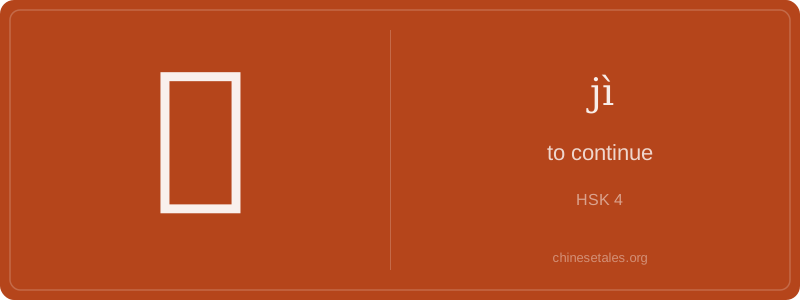
The earliest form of 继 appears in bronze inscriptions around 1000 BCE: a silk thread (糸, later simplified to 纟) beside a hand holding a spindle (the right side, now written as 米 + 又). The original pictograph showed someone actively twisting new thread onto an existing spool — literally joining one length to another. Over centuries, the spindle evolved: 米 (originally a stylized bundle of fibers) merged with 又 (a hand), while the left radical solidified into 纟 (silk thread), anchoring the character’s textile-rooted meaning of seamless connection.
This visual metaphor shaped its semantic journey: from physical thread-joining in Zhou dynasty ritual texts to abstract succession in Confucius’s Analects (e.g., ‘继周之礼’ — ‘continue the rites of the Zhou’). By the Han dynasty, 继 was standard for dynastic succession (e.g., 汉继秦 — ‘Han continued Qin’), cementing its association with legitimacy and unbroken transmission. Even today, its strokes echo that ancient hand at the loom — ten deliberate movements binding past to present.
Imagine you’re watching a traditional Chinese opera: the lead actor collapses mid-scene, but before the curtain falls, his apprentice steps forward — not to replace him, but to continue the role, same gestures, same voice, same spirit. That’s 继 (jì): it’s not just ‘go on’ like pressing play; it’s conscious, respectful, often solemn continuation — of a task, legacy, or duty. It carries weight, intention, and continuity across time.
Grammatically, 继 is rarely used alone. You’ll meet it in compounds like 继续 (jìxù, ‘to continue’) or as a verb prefix in formal writing: 继而 (jì’ér, ‘and then’), 继任 (jìrèn, ‘to succeed to a post’). Crucially, it’s not interchangeable with 延续 (yánxù) — which emphasizes duration — or 保持 (bǎochí) — which means ‘to maintain’. Learners often mistakenly use 继 for ‘to resume after a break’ (that’s 恢复 huīfù or 重新开始 chóngxīn kāishǐ); 继 implies unbroken lineage or succession, not pause-and-restart.
Culturally, 继 echoes Confucian values: inheriting family rites (继祖业 jì zǔyè), continuing scholarly traditions (继绝学 jì juéxué), even in modern contexts like ‘successor CEO’ (继任者). A classic pitfall? Using 继 directly before a noun without a verb — e.g., *继工作 is wrong; say 继续工作. Also, note its tone: jì (fourth tone), not jī — mispronouncing it as jī sounds like ‘chicken’ (鸡) and instantly breaks credibility!