续
Character Story & Explanation
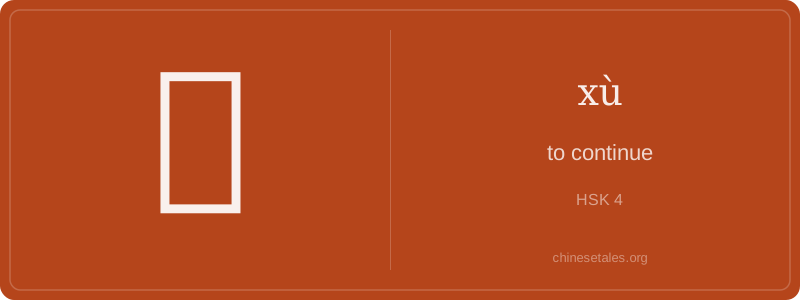
The earliest form of 续 appears in bronze inscriptions as a compound: left side was 糸 (a stylized skein of silk threads), right side was 肖 (a simplified form of 小, meaning ‘small’ or ‘to imitate’). Together, they depicted *tying a new thread onto an old one* — literally splicing silk to extend the length. Over centuries, 肖 evolved into 卖 (a phonetic component borrowed for sound, not meaning), while the left radical stabilized as 纟 (the modern silk-thread radical). By the Han dynasty, the character had settled into its current 11-stroke form: two dots (丶丶), then three strokes descending (the ‘thread’), followed by the ‘sell’ component — visually echoing the act of adding new material to an existing strand.
This silk-splicing origin directly shaped its semantic journey. In classical texts like the *Zuo Zhuan*, 续 appears in contexts like ‘续先君之业’ (‘continue the former ruler’s enterprise’), framing continuity as an ethical duty — just as a broken thread must be carefully rejoined to preserve the fabric’s integrity. Even today, the radical 纟 reminds us that continuation isn’t abstraction: it’s tactile, deliberate, and woven into the social fabric — whether mending relationships, renewing visas, or updating software licenses.
At its heart, 续 isn’t just ‘to continue’ — it’s about *intentional continuity*, the conscious choice to pick up where something left off: a story, a contract, a tradition, or even a conversation. In Chinese thinking, continuity isn’t passive; it’s relational and responsible — you don’t just ‘go on’, you *reconnect the thread*. That’s why 续 almost always appears with an explicit prior state: 续签 (renew a contract), 续写 (continue writing a novel), 续费 (recharge a subscription). It implies respect for what came before.
Grammatically, 续 is nearly always a verb prefixing another verb (续 + V), rarely standing alone. You won’t say ‘I continue’ — you’ll say ‘I continue studying’ (继续学习) or ‘they continued the meeting’ (他们继续开会). Crucially, it’s *not* interchangeable with 继续 (which is more general and abstract); 续 feels more concrete, transactional, and often bureaucratic — think renewals, extensions, and resumptions after interruption. Learners often mistakenly use it like English ‘continue’ intransitively, but native speakers instinctively pair it with a clear object or action.
Culturally, 续 reflects China’s deep-rooted value of *unbroken transmission*: lineage, skills, rituals, even internet subscriptions (续费 is ubiquitous!). A common mistake? Using 续 where 继续 fits better — e.g., saying ‘他续说话’ instead of ‘他继续说话’. The former sounds like he’s *renewing* his speech like a lapsed membership! Also, note that 续 never means ‘to resume after pause’ without implying formal reactivation — unlike English ‘continue’, which can be casual and momentary.