回
Character Story & Explanation
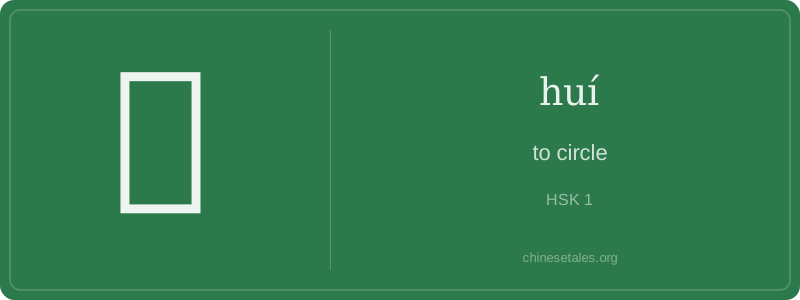
The earliest form of 回 appears in oracle bone inscriptions (c. 1200 BCE) as a symmetrical, nested square — — clearly depicting water swirling in a whirlpool or smoke coiling upward in a closed loop. Scribes drew two concentric squares (later simplified to one outer frame 囗 + inner cross-like strokes), capturing motion that bends, turns, and returns upon itself. Over centuries, the inner strokes evolved from irregular swirls to the clean, balanced ‘口’-within-‘囗’ structure we see today — still visually echoing enclosure and recurrence.
This ancient spiral image didn’t just describe physics — it seeded philosophy. In the *Zhuangzi*, ‘the Dao circles back’ (道回) evokes cosmic rhythm; in Tang poetry, 回 often describes moonlight ‘circling’ a courtyard or a lover’s gaze ‘returning’ again and again. Its visual containment (the 囗 radical — meaning ‘enclosure’) reinforces that ‘return’ isn’t random — it’s bounded, intentional, and rooted. Even today, the character’s symmetry whispers: to go away is easy; to truly 回 is to complete the shape of your journey.
At its heart, 回 (huí) isn’t just ‘to circle’ — it’s the Chinese mind’s elegant shorthand for *returning to a point*, whether physically, temporally, or conceptually. It carries a quiet sense of completion, repetition, and cyclical order — think of seasons returning, a question receiving an answer, or a traveler coming home. That’s why it feels so natural in contexts like ‘reply’ (回答 huídá) or ‘again’ (又回 yòu huí), where something loops back into place.
Grammatically, 回 is wonderfully flexible: as a verb, it means ‘to return’ (e.g., 回家 huí jiā — ‘go home’); as a measure word, it counts occurrences (e.g., 一回 yī huí — ‘one time’); and as part of compound verbs, it adds directionality (e.g., 回来 huílái — ‘come back’, 回去 huíqù — ‘go back’). Crucially, it’s rarely used alone — learners often mistakenly say *‘回’* when they mean *‘回来’* (‘come back’) or *‘回去’* (‘go back’); native speakers almost always add a directional complement.
Culturally, 回 reflects China’s deep appreciation for harmony, balance, and closure — things should complete their cycle, not vanish mid-arc. A common error? Using 回 for ‘to go somewhere else’ — no! It only implies movement *back toward origin*. Also, don’t confuse its measure-word use (一回) with 次 (cì); while both mean ‘time’, 回 feels more colloquial and narrative, like recounting a personal experience: ‘那回我迷路了’ (Nà huí wǒ mílù le — ‘That time, I got lost’).