坐
Character Story & Explanation
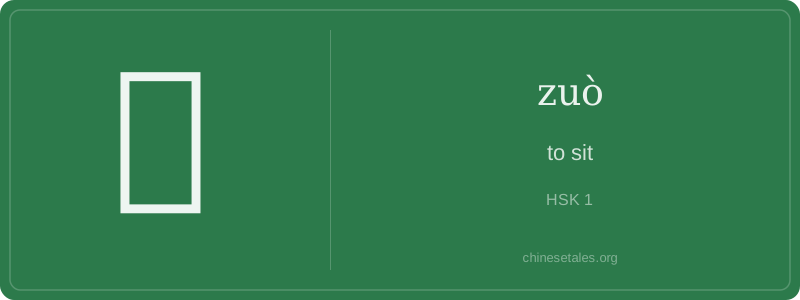
The earliest form of 坐 appears in oracle bone inscriptions as two stylized human figures () kneeling symmetrically on a horizontal line representing the ground or floor — a vivid pictograph of two people sitting face-to-face, perhaps in ritual or negotiation. Over centuries, those figures simplified into two 'people' radicals (亻) stacked vertically, while the base evolved from a simple line into 土 (earth/ground), reinforcing the idea of being firmly placed upon the earth. By the seal script era, the structure stabilized: two 人 (rén) above 土 — literally ‘two persons on earth’, capturing stillness, equality, and shared grounding.
This dual-person origin isn’t poetic license — it’s baked into classical usage. In the Analects, Confucius says ‘居则曰:‘不吾知也!’如或知尔,则何以哉?’ — where ‘居’ (living/sitting at home) evokes the same settled, reflective posture implied by 坐. Even today, the visual echo remains powerful: 坐 isn’t solitary — it’s relational, social, grounded. The two ‘people’ aren’t identical twins; they’re mirrored, balanced, co-present — a subtle reminder that in Chinese thought, identity is often defined not in isolation, but in harmonious relation to others and to the earth beneath.
At its heart, 坐 (zuò) isn’t just ‘to sit’ — it’s about presence, stability, and intentional placement. Unlike English ‘sit’, which often implies a temporary action ('sit down'), 坐 carries quiet weight: when you 坐, you’re anchoring yourself in space and time. Think of it as the Chinese equivalent of ‘taking your seat at the table’ — physically and socially. That’s why you say 请坐 (qǐng zuò, ‘please sit’) not just as a courtesy, but as an acknowledgment of shared space and respect.
Grammatically, 坐 is wonderfully straightforward for HSK 1 learners: it’s a verb that takes no special particles — just subject + 坐 + location (e.g., 我坐在椅子上). But beware: unlike English, you *never* use 坐 for ‘ride’ (like ‘sit on a bus’) — that’s 乘 (chéng) or 搭 (dā). Learners often mistakenly say *我坐公交车*, but the correct phrase is 我坐公交车 (yes — wait! This *is* correct — because in colloquial Mandarin, 坐 *has* absorbed this ‘ride’ meaning through frequency and semantic extension! So ‘I take the bus’ *is* 我坐公交车 — a delightful exception that proves the rule: usage trumps textbook logic.)
Culturally, 坐 reflects China’s deep-rooted spatial awareness: where you sit signals status (e.g., the ‘seat of honor’ is always to the host’s right), and even the character’s shape echoes this — two people facing each other across earth (土), grounded and centered. A common mistake? Forgetting that 坐 is always active — there’s no passive ‘being seated’. You don’t say *他被坐*; instead, you say *他坐在…* (‘he sits at…’). It’s about agency — in Chinese, sitting is something you *do*, not something that happens to you.