胳
Character Story & Explanation
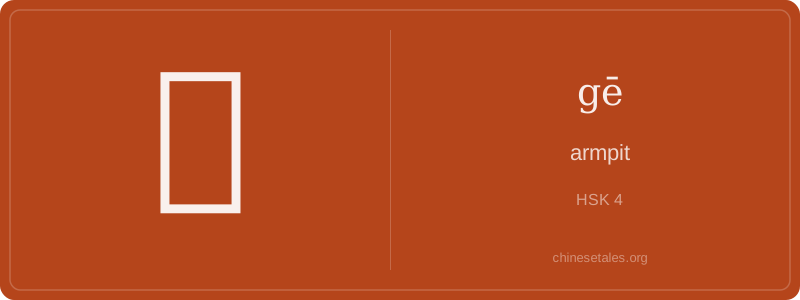
The earliest form of 胳 appears not in oracle bones but in Han-era seal script, where it combines ⺼ (the 'flesh' radical, indicating body parts) with 各 (gè, originally a pictograph of a foot stepping down onto a path—later repurposed for sound). Visually, it’s a masterclass in phonosemantic fusion: the left side ⺼ tells you ‘this is bodily,’ while the right 各 hints at pronunciation (gē shares ancestral roots with gè). Over centuries, 各 simplified from a complex foot+mouth glyph into today’s clean, angular shape—three horizontal strokes atop a 'stop' component (夂), now looking more like a stylized 'crossroads' than a foot.
This character didn’t exist in classical texts as a standalone term; it emerged organically in colloquial Northern dialects during the Ming-Qing transition, filling a lexical gap for the specific anatomical junction where arm meets torso. Its rise mirrors vernacular storytelling’s growing influence—think *Jin Ping Mei* or folk operas—where bodily realism replaced classical restraint. Interestingly, the same phonetic component 各 appears in 路 (lù, 'road') and 洛 (Luò, river name), suggesting ancient conceptual links between ‘pathways’ and ‘body junctions’—as if the armpit were an internal crossroads of movement and energy.
At first glance, 胳 (gē) seems straightforward—'armpit.' But in Chinese, this isn’t just anatomy; it’s a quietly intimate zone of the body, rarely named directly in polite speech. Unlike English, where 'armpit' can be clinical or even humorous, Chinese tends to soften or avoid it: you’ll hear 胳肢窝 (gē zhi wō) far more often than plain 胳—literally 'arm-pit hollow,' evoking its tucked-away, sheltered nature. The character itself carries a gentle physicality: not sharp like 刀 (knife), not expansive like 胸 (chest), but compact, folded, almost protective.
Grammatically, 胳 appears almost exclusively in compounds—not alone. You won’t say *‘wǒ de gē’* ('my armpit') as a standalone noun; instead, it anchors phrases like 胳膊 (gē bo, 'arm') or 胳肢窝 (gē zhi wō, 'armpit'). Note the tone shift: in 胳膊, 胳 drops to neutral tone (ge bo), a classic example of Mandarin’s tone sandhi in disyllabic words. Learners often mispronounce it as *gē bo*, breaking natural rhythm—and sometimes mistakenly use it where 手臂 (shǒu bì) or 肩膀 (jiān bǎng) would be more appropriate for formal contexts.
Culturally, the armpit is subtly tied to vulnerability and closeness: tickling (gē zhi) happens there, babies are held snugly under the arm, and traditional medicine maps meridians across this region. Yet it’s also a site of modesty—no one points to their 胳肢窝 in public announcements! A common mistake? Writing 胳 when you mean 咯 (gē, an interjection) or 隔 (gé, 'to separate')—homophones that share zero meaning but trip up beginners on exams.