脾
Character Story & Explanation
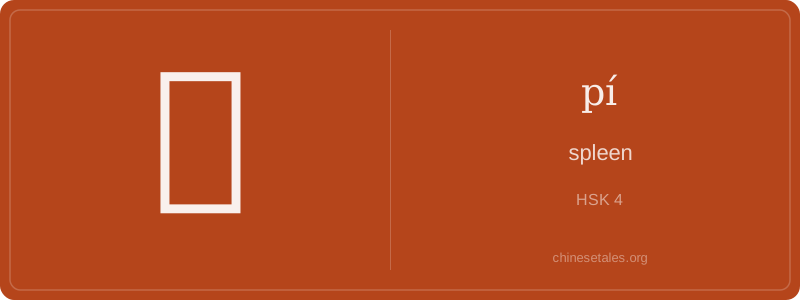
The earliest form of 脾 appears in bronze inscriptions around 1000 BCE — not as a detailed organ sketch, but as a stylized combination: the meat radical ⺼ (originally written as 月, picturing hanging strips of flesh) on the left, and a phonetic component 叚 (jiǎ, an archaic variant of 假) on the right. Over centuries, 叚 simplified into 卑 — which looks like ‘low’ (卑) but originally contributed sound, not meaning. By the Han dynasty, the character stabilized into today’s 12-stroke form: ⺼ + 卑, with the horizontal strokes of 卑 stacking like layered tissue — a subtle visual echo of the spleen’s soft, spongy texture beneath the ribs.
In the Huangdi Neijing (The Yellow Emperor’s Classic of Internal Medicine, c. 3rd century BCE), 脾 is elevated beyond anatomy: it’s the ‘root of postnatal qi’, transforming food into blood and essence. Its association with ‘thinking’ (思) and ‘worry’ (思虑) explains why classical poets described melancholy scholars as having ‘spleen-dampness’ — a physical metaphor for mental stagnation. The character’s visual humility — 卑 means ‘humble’ or ‘lowly’ — quietly reinforces its role as the unglamorous yet indispensable organ that quietly sustains life, never seeking attention like the heart or lungs.
At first glance, 脾 (pí) is just the anatomical word for 'spleen' — but in Chinese medicine and everyday speech, it’s far more alive than its Western counterpart. Unlike English, where 'spleen' is a dusty term reserved for biology class or Shakespearean metaphors ('ill-tempered as a spleen'), 脾 carries warm, functional weight: it governs digestion, transforms food into vital energy (qì), and even influences how we process emotions — especially worry and overthinking. To say someone has 'weak spleen energy' (脾虚, pí xū) isn’t medical jargon; it’s a common diagnosis for fatigue, bloating, or brain fog after too much stress or cold food.
Grammatically, 脾 rarely stands alone — it’s almost always in compounds (like 脾胃 or 脾气). You won’t say *‘wǒ de pí hěn hǎo’* (‘my spleen is fine’) — that sounds bizarrely clinical. Instead, you’ll hear phrases like *‘tā pí qì bú hǎo’* (‘his temper is bad’) — where 脾气 literally means ‘spleen energy’, but functions idiomatically as ‘temper’. This semantic leap — from organ to emotional disposition — reveals how deeply Chinese thought links physiology and psychology, without Cartesian separation.
Learners often mispronounce it as *bǐ* (confusing the radical ⺼ with 口) or mistakenly use it like an English noun in isolation. Also, don’t translate 脾气 directly as ‘spleen-qi’ — it’s a fixed idiom meaning ‘temper’ or ‘disposition’, and using it literally will confuse native speakers. Bonus quirk: In classical texts, 脾 was associated with the Earth element and late summer — the season of harvest *and* dampness, explaining why TCM warns against excessive raw salads in August!