膏
Character Story & Explanation
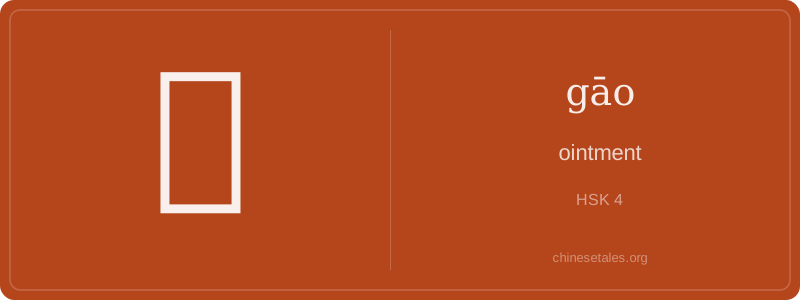
The earliest form of 膏 appears on Warring States bamboo slips — a vivid pictograph showing fat (⺼) dripping into a vessel (it later evolved into the top component, 月 + 羊 + 丶). The bottom part, (a variant of 㠯), originally depicted a hand holding a ladle, emphasizing the *act of collecting and refining* animal fat. Over centuries, the vessel simplified into the 月 radical (a variant of ⺼, not ‘moon’ here!), the fat-rendering process became abstracted into 羊 (sheep — a common source of rich fat), and the dot (丶) marked the precious droplet itself. By the Han dynasty, the character stabilized into today’s 14-stroke form: ⺼ + 羊 + 丶 — literally ‘meat + sheep + drop’.
This visual logic shaped its meaning: 膏 wasn’t just ‘fat’ — it was *refined, concentrated essence*. In the Book of Rites, 膏 referred to sacrificial animal fat offered to ancestors; in Li Shizhen’s Compendium of Materia Medica, it denoted slow-boiled herbal pastes meant to ‘nourish the marrow’. Even today, when Chinese say ‘膏肓’ (gāo huāng, ‘deep in the body’), they’re invoking the ancient belief that 膏 lies between ribs and heart — the deepest, most vital layer. The character doesn’t just name a substance — it maps an entire philosophy of density, nourishment, and inner depth.
Imagine you’re in a Beijing traditional medicine clinic — the air smells warm and herbal, like simmering cinnamon and aged deer antler. An elderly doctor hands you a small ceramic pot labeled gāo, its lid sealed with wax. Inside? Not just ‘ointment’ in the Western sense — it’s a thick, dark, syrupy *concentrate*, painstakingly boiled for days from dozens of herbs. That’s the soul of 膏: it’s not mere cream — it’s *substance made dense*, medicinal essence transformed through heat and time.
Grammatically, 膏 is almost always a noun, rarely used alone. You’ll meet it in compounds like 药膏 (yào gāo, 'medicated ointment') or 滋补膏 (zībǔ gāo, 'tonic paste'). It never takes aspect markers (no 膏了 or 膏过) — it’s a concrete, unchanging thing. Learners sometimes misread it as ‘paste’ or ‘glue’, but while glue sticks things together, 膏 *nourishes* — it’s deeply associated with internal cultivation, not adhesion. And yes, it’s pronounced gào in rare classical contexts like 膏车 (gào chē, 'to grease a cart axle'), but that’s archaic — at HSK 4, stick firmly to gāo.
Culturally, 膏 carries quiet reverence: it appears in Tang dynasty poetry describing scholar’s ink (墨膏, mò gāo), and in modern wellness culture as ‘gāo therapy’ — think goji-and-schisandra paste eaten each morning. The biggest trap? Confusing it with 高 (gāo, 'high') — same sound, totally different world. Remember: if there’s meat (⺼) involved, it’s about substance, not altitude.