举
Character Story & Explanation
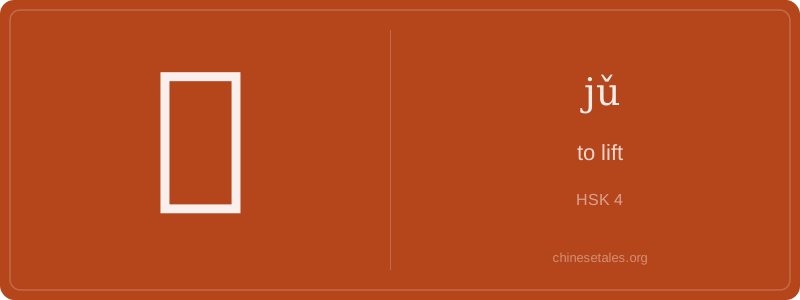
The earliest form of 举, found in bronze inscriptions around 1000 BCE, looked like two hands (又) lifting something — possibly a ceremonial vessel or a banner — above a base representing the ground or a platform. Over centuries, the ‘hands’ simplified into the top-left component (with the dot 丶 and bent stroke), while the lower part evolved from a pictograph of a standing figure or object being elevated into today’s 与-like shape. Crucially, the radical 丶 (dot) isn’t decorative — it marks the apex, the highest point reached by the lifted thing. By the Han dynasty, the character had stabilized into its modern 9-stroke form: a visual echo of effort, ascent, and intentionality.
This upward energy shaped its semantic journey. In the Book of Rites, 举 appears in rituals where elders ‘raise’ offerings to heaven; in the Records of the Grand Historian, it describes officials ‘elevating’ worthy candidates — linking physical action to moral authority. Even today, the dot radical whispers ‘peak,’ and the whole character feels like a tiny monument to vertical ambition — whether you’re hoisting a trophy or proposing a solution in a meeting.
At its heart, 举 (jǔ) is about upward motion — not just physical lifting, but also raising ideas, voices, or standards. Think of it as the Chinese verb for ‘elevating’ in every sense: you lift a box, raise your hand in class, propose a plan, or even hold a ceremony. It’s active, intentional, and often collective — rarely used for passive or accidental movement (that’s more 抬 or 拿). Notice how it almost always takes an object: 举起旗 (raise the flag), 举例说明 (give an example to explain), not just ‘I jǔ.’
Grammatically, 举 loves suffixes and compounds. Add -起 (qǐ) to emphasize completion (举起), -例 (lì) to mean ‘example’ (举例), or -办 (bàn) to form 举办 (to host/organize). A classic HSK 4 trap? Using 举 alone as a transitive verb without the right complement — learners say *‘他举了手’ (he jǔ le shǒu), which sounds incomplete; native speakers say 他举起了手 (he raised his hand) or simply 他举手 (he raises his hand) in habitual contexts. Also, 举 never means ‘to carry’ on your person — that’s 携 or 带.
Culturally, 举 carries Confucian weight: in imperial times, 举荐 (jǔjiàn) meant recommending someone for office — a deeply trusted act, since your reputation rose or fell with the person you ‘raised up.’ Today, 举国 (jǔguó, ‘entire nation’) echoes that collective elevation — e.g., 举国欢庆 (the whole nation celebrates). Learners often overuse it for ‘to hold’ (like holding a phone), but that’s usually 拿 or 握. Remember: 举 lifts *up*, not just *holds*.