航
Character Story & Explanation
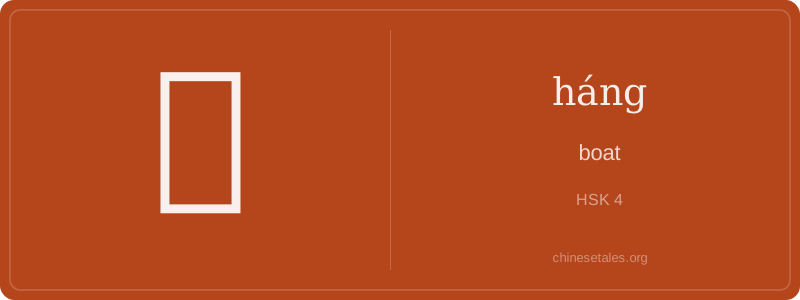
The earliest form of 航 appears in bronze inscriptions around 800 BCE, built from two clear elements: the radical 舟 (zhōu, ‘boat’) on the left — originally a pictograph of a simple dugout canoe with raised bow and stern — and the right side 行 (xíng, ‘to go, to walk’), which itself was a pair of crossed paths (彳 + 彳 + 亍). This wasn’t just ‘boat’ plus ‘go’ — it was a deliberate compound: ‘boat moving along a path on water.’ Over centuries, the 舟 radical shrank and stylized, losing its curved hull shape; 行 simplified from six strokes to five, and the two components fused into today’s clean, balanced 10-stroke structure.
By the Han dynasty, 航 had crystallized as a literary verb meaning ‘to navigate’ — appearing in texts like the *Book of Han* describing imperial maritime logistics. Its semantic reach expanded dramatically during the Ming dynasty, when Zheng He’s treasure fleets made ‘navigation’ a national obsession. Even then, 航 never meant ‘boat’ alone — it always implied *controlled, directional motion across liquid space*. That ancient fusion of vessel + path remains alive in every modern usage: from ships crossing oceans to rockets traversing the void — all are ‘sailing’ in Chinese conceptual grammar.
Don’t be fooled by the English gloss 'boat' — 航 (háng) isn’t about a vessel sitting still in a harbor. It’s all about *movement*: specifically, the act of navigating or sailing *across water*. Think of it as the verb ‘to sail’ or ‘to navigate,’ not the noun ‘boat.’ That’s why you’ll almost never see 航 alone meaning ‘a boat’ — it’s nearly always part of compounds like 航行 (háng xíng, ‘to sail/navigate’) or 航空 (háng kōng, ‘aviation’ — literally ‘sailing through air’!).
Grammatically, 航 is almost exclusively used in formal or technical contexts — news reports, transportation announcements, and scientific writing. You won’t hear it in casual speech like ‘I took a boat to the island’ (that’s more 坐船 zuò chuán). Instead, you’ll read: ‘这艘货轮将航行至新加坡’ (This cargo ship will sail to Singapore). Notice how 航行 functions as a single verb — the character rarely stands solo.
Culturally, 航 carries a sense of purposeful, long-distance travel — even when extended metaphorically. In modern Chinese, 航空 (aviation), 航天 (spaceflight), and 航海 (maritime navigation) all reflect China’s deep-rooted emphasis on exploration, sovereignty, and technological advancement. A common mistake? Using 航 where you need 船 (chuán, ‘boat’). Saying *‘我坐航去上海’* sounds like ‘I ride ‘navigation’ to Shanghai’ — nonsensical! Remember: 航 = action, not object.