详
Character Story & Explanation
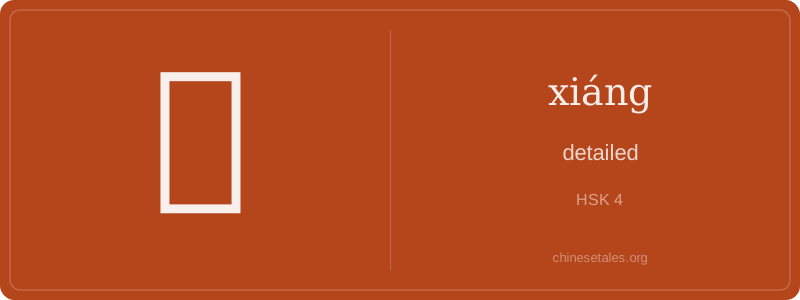
The earliest form of 详 appears in bronze inscriptions (c. 1000 BCE) as a compound character: left side was 言 (yán, 'speech'), and right side was 羊 (yáng, 'sheep') — not as livestock, but as a phonetic loan symbolizing auspiciousness and ritual purity. Over time, the sheep component simplified into the modern 阳-like shape (⺊ + 丿 + 一), losing its literal animal form but retaining its sound value. The eight strokes we write today — starting with the 讠 radical (two strokes: point + vertical) followed by six careful, balanced strokes — evolved to reflect both linguistic efficiency and visual harmony: every stroke supports the sense of measured, deliberate articulation.
By the Warring States period, 详 shifted from its original meaning of 'to inquire carefully' (as in classical texts like the *Zuo Zhuan*) to 'to state fully and clearly.' Its association with ritual speech and divination gave it weight: in ancient court documents, '详奏' meant 'report with full ritual fidelity.' Mencius even praised rulers who '不详察而听之' — 'do not examine thoroughly before accepting reports' — highlighting how deeply 详 was tied to moral responsibility. The character’s enduring visual balance — concise radical, elaborated right side — mirrors its semantic promise: speak briefly, but mean everything.
Think of 详 (xiáng) as the Chinese equivalent of a meticulous editor with a red pen — not just 'detailed,' but *intentionally, thoroughly, and sometimes exhaustively* detailed. In English, 'detailed' is often neutral or even slightly negative ('too detailed'), but in Chinese, 详 carries a quiet authority: it implies rigor, reliability, and trustworthiness — like the footnotes in a peer-reviewed journal or the specifications in an engineering blueprint. You’ll see it in formal writing, official documents, and academic contexts where precision matters.
Grammatically, 详 most commonly appears in compound adjectives (e.g., 详细说明 — 'detailed explanation') or as part of the pattern '详 + verb' meaning 'to elaborate on X' (e.g., 详述 — 'to describe in detail'). Crucially, it’s rarely used alone as a standalone adjective — you won’t say *‘这个很详’; instead, you’d say *‘这个很详细’* (using the full word). Learners often mistakenly omit the -细 suffix, leading to unnatural or ungrammatical speech.
Culturally, 详 reflects Confucian values of thoroughness and respect for knowledge — skipping details isn’t just sloppy; it can imply negligence or lack of sincerity. A common mistake is confusing 详 with 明 (míng, 'clear') or 精 (jīng, 'precise'): while all suggest clarity, 详 emphasizes *completeness of coverage*, not just sharpness or accuracy. Also, note that 详 is almost never used in casual spoken Chinese — its presence signals formality, so dropping it from a report or email subtly lowers your credibility.