诚
Character Story & Explanation
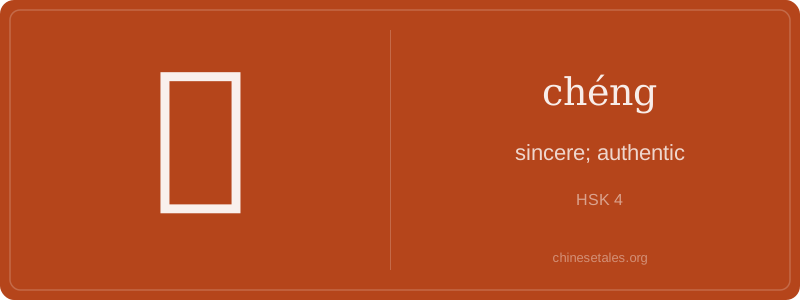
The earliest form of 诚 appears in bronze inscriptions around 1000 BCE — not as a single character, but as part of the compound 城 (chéng, 'city wall'), where the right side was 成 (chéng, 'to complete, succeed'). The left side was 言 (yán, 'speech'), added later to emphasize that authenticity must be *declared*, not just felt. By the Warring States period, scribes simplified the complex bronze form into the modern 8-stroke structure: first the radical 讠 (a stylized mouth/speech), then 成 — literally 'speech + completion'. Visually, it’s a promise made and fulfilled: your words (讠) reach full realization (成).
This visual logic shaped its meaning profoundly. In the Doctrine of the Mean (Zhōng Yōng), Confucius declares: 'Sincerity (诚) is the way of Heaven; to think sincerely is the way of man.' Here, 诚 isn’t mere honesty — it’s cosmic alignment: when human intention matches heavenly principle, action becomes inevitable and true. Later, Zhu Xi described 诚 as 'the unmoving center of all things' — the still point from which virtue radiates. Its stroke order even reflects this: the final dot of 成 lands like a seal pressed onto speech, locking word and deed together forever.
Think of 诚 (chéng) as Chinese culture’s version of a notarized signature — not just 'sincere' in the emotional sense, but *legally and morally binding* authenticity. In English, 'sincere' often describes feeling; in Chinese, 诚 carries weightier connotations: it’s the bedrock of trust in relationships, business, and self-cultivation. You wouldn’t say 'I feel 诚' — it’s not an emotion you have, but a state you *embody* or *uphold*. That’s why it appears in formal phrases like 诚实守信 (honesty and keeping promises), not casual chats about mood.
Grammatically, 诚 rarely stands alone as a verb or adjective in modern speech — it’s almost always part of compounds (e.g., 诚实, 真诚) or used adverbially in classical-style expressions like 诚然 (chéng rán, 'indeed, truly'). Learners often wrongly try to use it like 'sincere' in English sentences ('He is 诚'), but native speakers say 他很真诚 (tā hěn zhēn chéng) — adding 真 or 实 for naturalness. Even in HSK 4 contexts, 诚 shines in set phrases, not free-standing descriptions.
Culturally, 诚 is one of the Five Constant Virtues (五常) in Confucianism — right alongside rén (benevolence) and yì (righteousness). It’s not about being 'nice'; it’s about aligning your words with your inner reality — no spin, no face-saving evasion. A common mistake? Over-translating it as 'honest' and missing its deeper resonance with integrity and ontological truth. When a Chinese person says 这件事要诚心去做 (zhè jiàn shì yào chéng xīn qù zuò), they’re invoking moral gravity — not just 'do it sincerely', but 'do it with your whole authentic self, without pretense'.