警
Character Story & Explanation
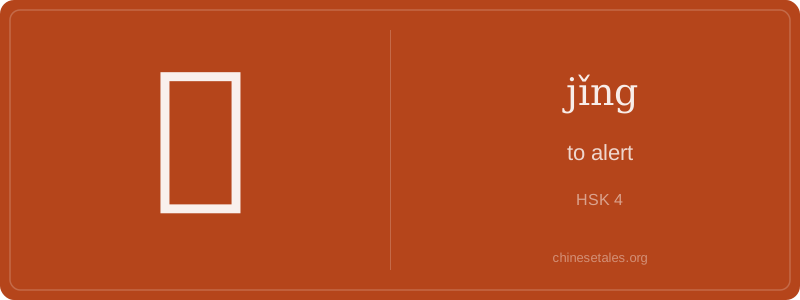
The earliest form of 警 appears in bronze inscriptions around 1000 BCE—not as a pictograph, but as a phonosemantic compound already. Its left side 言 (yán, ‘speech’) was the semantic indicator, signaling that this character involved verbal communication or declaration. The right side was originally 敬 (jìng, ‘to respect, revere’), acting as the phonetic component—and yes, that’s why 警 and 敬 share the same pronunciation today. Over centuries, the right-hand 敬 simplified: its top 口 (mouth) and middle 卣 (ancient wine vessel, later stylized) collapsed into 立 (lì, ‘to stand’) + 敬’s lower part, eventually becoming the modern 狗-like shape at the top-right, while the bottom evolved into the crisp, angular strokes we see now—19 strokes total, each reinforcing precision and urgency.
This visual evolution mirrors its semantic journey: from ‘reverent speech’ (in early Zhou ritual contexts—warnings spoken with solemnity before ancestors) to ‘urgent verbal warning’. By the Han dynasty, 警 appeared in texts like the *Huainanzi* advising rulers to ‘警于未形’ (jǐng yú wèi xíng)—‘be vigilant before danger takes shape’. Its dual role—linguistic (speech-based warning) and ethical (moral vigilance)—stuck: Confucius praised ‘内省不疚,夫何忧何惧?’ (inner self-examination without guilt—why worry or fear?), a mindset deeply connected to 警. Even today, 警惕 doesn’t just mean ‘be careful’—it means ‘hold your mind upright, like a sentry guarding virtue’.
Think of 警 (jǐng) as China’s linguistic equivalent of a flashing red siren—immediate, authoritative, and impossible to ignore. Unlike English ‘alert’, which can be gentle (‘a gentle alert’) or even digital (‘phone alert’), 警 carries an inherent gravity: it implies urgency, official warning, or moral vigilance—like a fire alarm *and* a conscience in one character. It rarely stands alone; instead, it anchors compound nouns (警察, 警告) or appears in formal verbs like 警惕 (jǐngtì, ‘to be vigilant’). You won’t say ‘I alert you’ with 警 as a verb—instead, you’d use 告诉 or 提醒. Learners often wrongly try to use it transitively like ‘I jǐng you!’ — but nope: 警 is almost always the *root*, not the action.
Grammatically, 警 shines in fixed two-character compounds. As the first character, it signals seriousness: 警察 (police officer), 警报 (alarm), 警示 (warning sign). As the second, it deepens meaning: 戒警 (rare, archaic ‘on guard’) or 自警 (zìjǐng, ‘self-alertness’ — a Confucian ideal of moral self-discipline). Even its tone—third tone—mirrors its function: rising then falling, like a siren’s wail that grabs attention before settling into gravity.
Culturally, 警 isn’t just about danger—it’s tied to social order and ethical awareness. In classical texts, 警戒 (jǐngjiè) meant both military readiness *and* moral caution. Modern learners often misread 警 as ‘police’ full stop—but while 警察 means ‘police’, 警 itself means *the act/state of being on alert*. Skipping this nuance leads to errors like writing ‘他很警’ (nonsensical) instead of ‘他很警惕’ (he’s very vigilant). Also: don’t confuse its radical 言 (speech) with silence—here, speech *is* the alarm: a warning cry, not small talk.