译
Character Story & Explanation
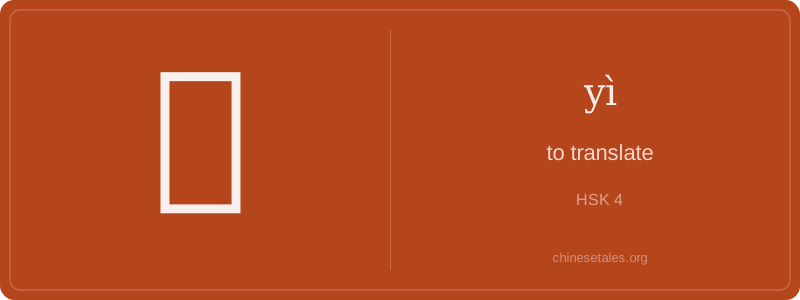
The earliest form of 译 appears in bronze inscriptions around 1000 BCE — not as a pictograph, but as a compound ideograph. Its ancient shape combined 言 (yán, ‘speech’) on the left and 易 (yì, ‘change, exchange’) on the right — no ‘tiger’ or ‘tree’, just pure conceptual fusion: ‘speech + change’. Over time, 言 simplified to the modern 讠 radical (‘speech’ reduced to two strokes), while 易 evolved from a pictograph of a lizard shedding skin (symbolizing transformation) into today’s elegant seven-stroke form. By the Han dynasty, the character was standardized as 譯 — later simplified to 译 in 1956, dropping the ‘speech’ component’s full form but keeping its essence intact.
This visual logic mirrors its philosophical weight: translation in classical China wasn’t mimicry — it was *ethical transformation*. The great translator Kumārajīva (344–413 CE) insisted sutras must be ‘translated to convey meaning, not just words’ (译义不译字). His team used 译 to render Sanskrit into resonant, poetic Chinese — proving the character wasn’t about swapping symbols, but re-creating meaning across ontological divides. Even today, when you write 译, you’re echoing that ancient pact: language isn’t transferred — it’s reborn.
At its heart, 译 (yì) isn’t just ‘to translate’ — it’s the *act of bridging worlds*. In Chinese, this verb carries quiet authority: it implies fidelity, cultural sensitivity, and intellectual labor. Unlike English ‘translate’, which can sound mechanical, 译 always suggests intentionality — you don’t 译 by accident; you 译 a poem, 译 a treaty, or 译 for a diplomat. It’s almost never used intransitively (you wouldn’t say ‘I translate’ alone); it needs an object: 译一本书 (yì yī běn shū — ‘translate a book’) or 译成英文 (yì chéng Yīngwén — ‘translate into English’).
Grammatically, 译 is wonderfully flexible: it works as a verb (她正在译小说 — ‘She’s translating a novel’), a noun in compounds (译者 — ‘translator’), and even in passive constructions with 被 (bèi): 这本书已被译成20种语言 (‘This book has been translated into 20 languages’). A classic learner trap? Using 译 where you need 说 (shuō) or 讲 (jiǎng) — like saying *我译英语* instead of *我说英语* (‘I speak English’). Remember: 译 moves meaning *between* languages; 说 and 讲 operate *within* one.
Culturally, 译 evokes centuries of cross-cultural exchange — from Buddhist sutras translated in Tang-dynasty monasteries to modern AI tools labeled 机器翻译 (jīqì fānyì). Interestingly, Chinese rarely uses 译 for interpreting spoken language (that’s 口译 — kǒuyì); written translation is its default domain. Learners also overlook that 译 is almost always formal — you’d use it for documents, not texting slang. That’s why it’s HSK 4: it marks the shift from everyday speech to precise, literate communication.