貌
Character Story & Explanation
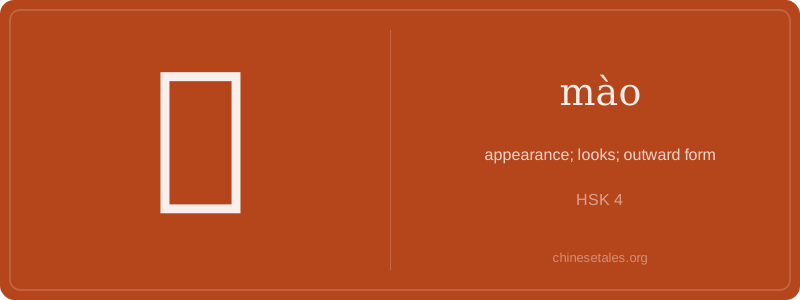
Trace 貌 back to its oracle bone roots, and you’ll find no clear pictograph—because it wasn’t originally pictorial! Its earliest form (in bronze inscriptions) was a phonetic-semantic compound: the radical 豸 (zhì, 'beast with long spine') provided semantic weight—suggesting wildness, untamed nature—while the top part, 卩 (jié, a kneeling figure), hinted at posture, stance, or outward presentation. Over centuries, 卩 morphed into 白 (bái, 'white'), likely due to scribal simplification and sound borrowing (both 卩 and 白 were near-homophones in Old Chinese). By the Han dynasty, the modern shape stabilized: 豸 + 白 = 14 strokes, visually balancing animal instinct (豸) and visible clarity (白).
This evolution mirrors its meaning shift: from early references to 'the look of a beast'—implying raw, unmediated presence—to classical texts like the *Book of Rites*, where 貌 became codified as one of the ‘Five Appearances’ (五貌) governing ritual comportment. The character literally embodies the Confucian project: taming primal energy (豸) into socially legible form (white = purity, visibility). Even today, when we say 仪态万方 (yí tài wàn fāng, 'graceful bearing in myriad forms'), we’re echoing that ancient tension between inner nature and cultivated mào.
At its heart, 貌 (mào) isn’t just about physical looks—it’s about *perceived form*, the surface layer through which identity, intent, or even morality is read. In Chinese thought, appearance isn’t superficial fluff; it’s socially legible data—think of Confucius praising ‘a gentleman’s dignified mào’ (君子之貌) as inseparable from inner virtue. That’s why you’ll hear 貌 in formal contexts like 外貌 (wài mào, 'external appearance') or 面貌 (miàn mào, 'appearance/aspect'), but rarely in casual selfies: it carries quiet gravity, almost bureaucratic precision.
Grammatically, 貌 is almost never used alone—it’s a bound morpheme, glued into compound nouns or fixed phrases. You won’t say *‘Tā hěn mào’* (‘He is very appearance’)—that’s ungrammatical nonsense. Instead, it pairs with modifiers: 仪表不凡 (yí biǎo bù fán, 'unusually impressive bearing'), or functions adverbially in literary patterns like 貌似 (mào sì, 'seemingly'). Learners often mistakenly treat it like an adjective (like 好看), but it resists standalone use—it’s a linguistic lens, not a lens cap.
Culturally, 貌 reveals how deeply Chinese language ties perception to judgment: 面貌一新 (miàn mào yī xīn, 'appearance completely renewed') describes both a renovated building *and* a person’s transformed character after self-cultivation. A common error? Over-translating 貌 as 'face'—but that’s 脸 (liǎn); 貌 is broader, more abstract, and always contextual. It’s the difference between pointing at someone’s nose (liǎn) and assessing their entire social presence (mào).