负
Character Story & Explanation
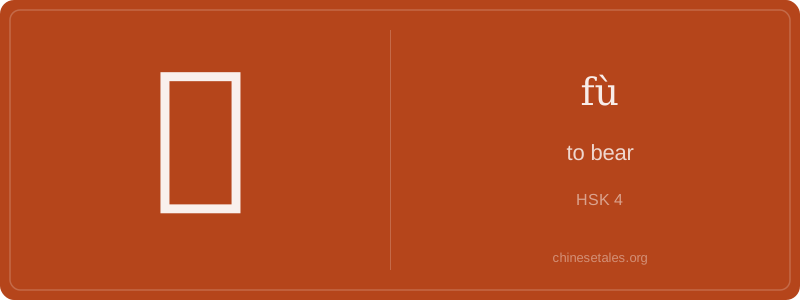
The earliest form of 负 appears on Shang dynasty oracle bones as a person (人) bent forward under a heavy object — sometimes depicted as a curved line or a shell-like shape above them. That upper part evolved into today’s + 一 (a downward stroke and horizontal bar), while the lower person became 匕 — a stylized, kneeling human figure. Crucially, the radical 贝 (bèi, ‘shell’) wasn’t originally part of it! It was added later during the Han dynasty, when shell money symbolized value — turning ‘bearing a load’ into ‘bearing financial or moral obligation’.
This shift from physical to ethical weight is profound. In the Classic of Filial Piety, 子曰:‘身体发肤,受之父母,不敢毁伤,孝之始也。’ — and by extension, one must 负起 this sacred trust. By the Tang dynasty, poets like Du Fu used 负 to convey existential burden: ‘名岂文章著,官应老病休。飘飘何所似?天地一沙鸥。’ — his fame ‘bears’ irony, his office ‘bears’ decline. Visually, those six strokes — especially the sharp downward stroke (丿) pressing down on the person — still whisper pressure, duty, and quiet endurance.
At its heart, 负 (fù) isn’t just ‘to bear’ like lifting a box — it’s about carrying weight that matters: responsibility, debt, guilt, or expectation. In Chinese thought, ‘bearing’ is rarely neutral; it’s deeply relational and moral. You don’t just ‘bear a bag’ — you 负责 (bèi zé) ‘bear responsibility’, 负债 (fù zhài) ‘bear debt’, or even 负罪 (fù zuì) ‘bear guilt’. This reflects a worldview where identity is woven through obligation — to family, society, history.
Grammatically, 负 is almost never used alone in modern speech — it’s the sturdy backbone of compound verbs and nouns. It doesn’t take aspect particles like 了 or 过 directly (*负了, *负过), so learners often overextend it like English ‘bear’. Instead, it appears in fixed two-character words: 负责, 负担, 负重. Even in passive constructions, it pairs with 被 (e.g., 被负于…), but far more commonly, it hides inside verbs like 承担 (chénɡ dān) — where 负 is the silent semantic engine.
Culturally, 负 carries quiet gravity — think of the Confucian ideal of the junzi (gentleman) who ‘bears virtue without complaint’. Learners mistakenly use it for physical carrying (use 拿, 提, or 背 instead); worse, they confuse 负债 (fù zhài, ‘in debt’) with 欠债 (qiàn zhài), not realizing 负 implies an acknowledged, almost honorable burden, while 欠 is more transactional. Also, note: when meaning ‘negative’ (as in math), it’s always written as 负号 (fù hào), never just 负 — context is king.