货
Character Story & Explanation
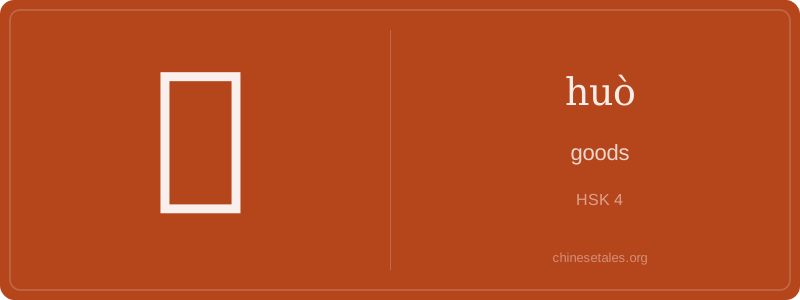
The earliest form of 货 appears in late Shang oracle bones and Zhou bronze inscriptions as a combination of 貝 (bèi, cowrie shell — ancient money) and 化 (huà, to change/transform). Visually, it was a simplified shell glyph beside two interlocking lines representing exchange or conversion. Over centuries, the 化 component streamlined: the left side became the modern ‘化’-like top-right hook and dot, while the bottom evolved into the horizontal stroke and downward sweep we see today — all cradled within the unmistakable 贝 radical at the bottom, anchoring its monetary soul.
This visual marriage of ‘shell’ + ‘transformation’ perfectly captured its original meaning: ‘that which changes hands as value’. By the Warring States period, 货 appeared in texts like the *Guanzi* discussing grain and silk as state-regulated ‘huò’, and in the *Shuōwén Jiězì* (121 CE), Xu Shen defined it precisely as ‘bèi zhōng zhī wù’ — ‘things circulating as shell-money’. Even Confucius criticized merchants who ‘zhēng huò’ (compete over goods), revealing how early the character carried moral weight around profit. Its shape never lost that core idea: every stroke whispers ‘exchange’.
Imagine you’re bargaining in a bustling Shanghai night market — vendor waving a neon-lit plastic fan, shouting 'Huo! Huo! Zhè shì xīn huò!' (‘Goods! Goods! This is new stock!’). That ‘huò’ isn’t just ‘stuff’ — it’s *market-ready, exchangeable, value-tagged* stuff. In Chinese, 货 carries the quiet hum of commerce: not raw materials or abstract concepts, but things *meant to be sold, shipped, or judged as quality*. It’s rarely used alone — you’ll almost always see it in compounds like 货物 (goods), 货柜 (shipping container), or even slang like 水货 (gray-market goods).
Grammatically, 货 is a noun that resists bare use — saying just ‘huò’ feels incomplete, like saying ‘the merchandise’ without context. You’ll hear it after measure words (yī pǐ huò — ‘a batch of goods’) or in fixed phrases. Watch out: learners often overgeneralize it as ‘thing’ (like English ‘stuff’), but 货 implies *commodity status* — your laptop is 电子产品, not *huò*, unless you’re reselling it. Also, avoid using it for people — calling someone ‘huò’ is deeply insulting (e.g., ‘rén huò’ = ‘human goods’, dehumanizing slang).
Culturally, 货 subtly echoes ancient China’s shell-based economy: its 贝 (shell) radical isn’t decorative — it’s a fossilized reminder that this character began with *actual currency*. Today, it still flavors business language with historical weight: when officials say ‘qīng lǐ jī chǔ huò’ (‘clear outdated inventory’), they’re invoking millennia of trade logic. And yes — that’s why ‘huò’ sounds like ‘ho’ (as in ‘ho-ho-ho’): think of Santa checking his *stock* — not toys, but *huò*.