责
Character Story & Explanation
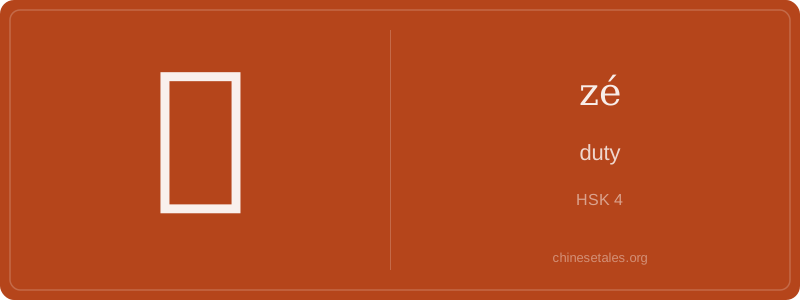
The earliest form of 责 appears in bronze inscriptions as a combination of 貝 (bèi, 'cowrie shell', symbolizing value or wealth) and 去 (qù, 'to go away'), but with an added hand-like stroke (⺅) above — suggesting a hand *removing* or *claiming* something valuable. Over centuries, the top evolved into the simplified 朿 (cì)-like shape we see today (the two diagonal strokes + horizontal), while the bottom solidified into 貝 — no longer just 'shell', but a marker for value-based obligation. By the Han dynasty, the character had stabilized into its modern eight-stroke form, visually balancing authority (top) and worth (bottom).
This evolution mirrors its semantic journey: from 'to demand repayment' (a financial claim on a debt, hence 貝) to 'to demand moral reckoning'. In the *Zuo Zhuan*, 责 appears in contexts like '责其不忠' ('blame him for disloyalty') — already layered with ethical weight. The visual tension between the sharp, descending top strokes (suggesting pressure or judgment) and the grounded, rounded 負 (bèi) base (value at stake) makes the character itself a miniature courtroom: justice isn’t abstract — it’s a transaction with consequences.
Think of 责 (zé) as Chinese culture’s version of a signed contract — not on paper, but in the soul. Its core meaning isn’t just 'duty' in the abstract; it’s *moral accountability*: the weight you carry when you’ve promised something, made a mistake, or hold a role (parent, leader, student). Unlike English 'duty', which can feel optional or ceremonial, 责 implies consequence — you’re answerable, and if you fail, you’ll be held to account.
Grammatically, 责 is rarely used alone. It shines in compounds like 责任 (zérèn, 'responsibility') or as a verb in structures like 责备 (zébèi, 'to blame'). Crucially, it’s almost never the main verb in casual speech — you won’t say 'I duty' — but appears in formal writing, official notices, or moral discourse. A classic learner trap? Using 责 as a standalone noun like 'duty' — instead, say 我的责任 (wǒ de zérèn, 'my responsibility') or use it only in set phrases.
Culturally, 责 carries Confucian gravity: it links personal conduct to social harmony. In classical texts like the *Analects*, failing one’s 责 could disrupt family order or state stability. Modern usage retains that seriousness — news headlines use 责任追究 (zérèn zhuījiū, 'accountability investigation') after accidents, not 'duty review'. Learners often soften it too much; remember: 责 doesn’t whisper — it testifies.