费
Character Story & Explanation
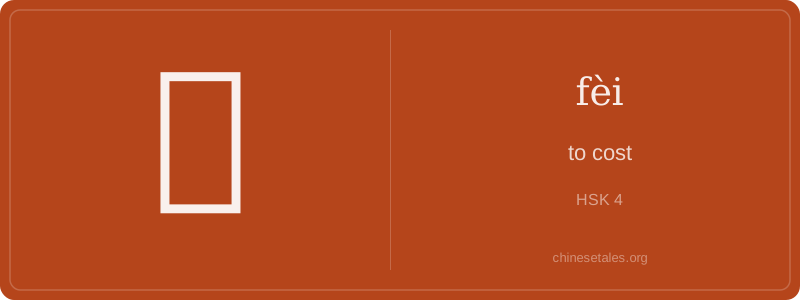
The earliest form of 费 appears in bronze inscriptions around 1000 BCE: a stylized shell (贝, the ancient currency) paired with a hand-like component (弗) suggesting ‘breaking apart’ or ‘pulling away’. Think of a hand prying open a shell — not to collect wealth, but to *expend* it. Over centuries, the shell radical stayed anchored at the bottom, while the top evolved from a complex pictograph of crossed lines (indicating ‘division’ or ‘removal’) into today’s simplified 弗 — two horizontal strokes crossing a vertical line, visually echoing ‘separation’ or ‘loss’. By the Han dynasty, the character had stabilized into its modern 9-stroke form: 贝 (4 strokes) + 弗 (5 strokes), perfectly balanced yet quietly tense.
This visual duality — shell (value) + ‘unbinding’ (弗) — seeded its semantic core: *the act of relinquishing something valuable*. In classical texts like the *Zuo Zhuan*, 费 appears in phrases like ‘费财劳民’ (wasting wealth and exhausting the people), linking expenditure directly to moral consequence. Its meaning never narrowed to mere money — early usage already included ‘to expend effort’ or ‘to trouble oneself’, proving that in ancient China, spending money and spending energy were morally equivalent acts of depletion. The character doesn’t just record cost — it judges it.
At its heart, 费 (fèi) isn’t just ‘to cost’ — it’s the quiet hum of economic consciousness in Chinese daily life. Unlike English’s neutral ‘cost’, 费 carries a subtle emotional weight: it implies effort, sacrifice, or even regret about resources spent — time, money, energy, or emotion. You’ll hear it in sighs over a high phone bill (话费太贵了) or admiration for someone who ‘spends’ great effort on a skill (费心练习). It’s rarely used alone as a verb; instead, it appears in compounds (花费, 费用) or as part of the common verb phrase 花费 (huā fèi), where 花 does the ‘spending’ and 费 reinforces the *costly* nature of the act.
Grammatically, learners often stumble by trying to use 费 as a standalone verb like ‘to cost’ in English. You don’t say *‘这个手机费我三千块’ — that’s ungrammatical. Instead, you need 花费 (‘This phone costs me 3,000 yuan’ → 这个手机花了我三千块) or the passive construction 这个手机要花三千块. Also note: 费 is almost never used with ‘it costs X’ impersonally — no ‘It fèis 50 kuài’ — Chinese prefers 要花 / 得花 / 价格是.
Culturally, 费 reflects a deep-rooted awareness of resource stewardship — not just money, but the invisible currency of time and care. That’s why we say 费神 (fèi shén, ‘to exhaust one’s spirit’) or 费劲 (fèi jìn, ‘to take great effort’): every ‘fee’ is measured in human energy. A common mistake? Overusing 费 where 花 suffices — e.g., saying *‘费时间’ instead of the natural 花时间 (though 费时间 *is* acceptable in formal/written contexts, it sounds stiffer and more critical).