贺
Character Story & Explanation
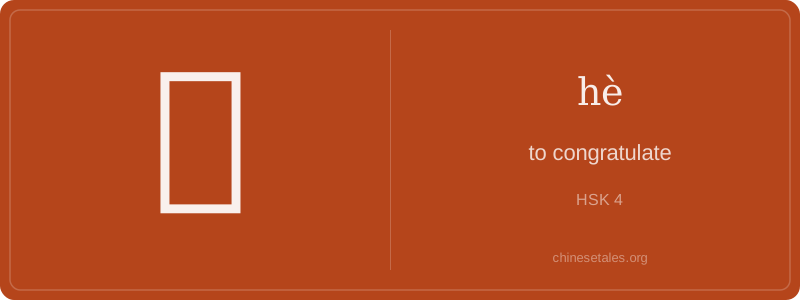
The earliest form of 贺 appears in bronze inscriptions (c. 1000 BCE) as a compound: the left side showed a person (人) with arms raised in gesture, and the right side depicted a shell (貝), symbolizing valuable gifts. Over centuries, the person evolved into the simplified 丷 + 冖 shape atop the character (now read as 加 jiā, meaning ‘to add’), while the shell remained firmly at the bottom as 贝 — anchoring the idea of giving something precious to mark joy. By the Han dynasty, the structure stabilized: 加 (addition) over 贝 (wealth/gift), visually declaring ‘adding value to another’s happiness.’
This visual logic shaped its meaning: from early texts like the *Zuo Zhuan*, 贺 described ritual acts — presenting jade or silk to honor a ruler’s victory or a noble’s marriage. Confucius even criticized hollow 贺 without genuine intent (Analects 3.25), showing how early the character encoded moral weight. The ‘shell’ radical wasn’t decorative: in ancient China, shells were currency, so 贺 literally meant ‘to present valuables in celebration’ — a fusion of material generosity and emotional resonance that still echoes in today’s red envelopes and wedding gifts.
At its heart, 贺 (hè) isn’t just ‘to congratulate’ — it’s the warm, intentional act of *joining* someone else’s joy. Unlike English ‘congrats,’ which can be tossed off casually, 贺 carries a subtle weight of sincerity and social alignment: you’re not just observing happiness—you’re stepping into it with them. It’s rarely used alone; instead, it appears in formal verbs like 祝贺 (zhù hè) or as part of written greetings (贺卡 hè kǎ), reflecting how deeply Chinese culture ties celebration to ritual and relational harmony.
Grammatically, 贺 almost never stands solo as a main verb in modern spoken Mandarin (you wouldn’t say *‘I hè you’*). Instead, it pairs with 祝 (zhù) to form 祝贺 — the standard verb for ‘to congratulate.’ It also appears in passive or honorific constructions like 恭喜祝贺 (gōng xǐ zhù hè), where repetition adds gravitas. Learners often mistakenly use 贺 alone like an English verb — a red flag that instantly sounds archaic or poetic (think classical poetry, not WeChat messages).
Culturally, 贺 reveals how deeply Chinese values link language to propriety: the character’s ‘shell’ radical (贝) hints at ancient wealth-based rituals — congratulations were once tied to gift-giving, not just words. Today, misusing 贺 (e.g., omitting 祝 in casual speech) doesn’t break grammar, but subtly undermines tone — like saying ‘felicitations!’ at a birthday party. Native speakers instinctively reach for 恭喜 first; 贺 is the polished, ceremonial cousin — reserved for weddings, promotions, or official announcements.