赢
Character Story & Explanation
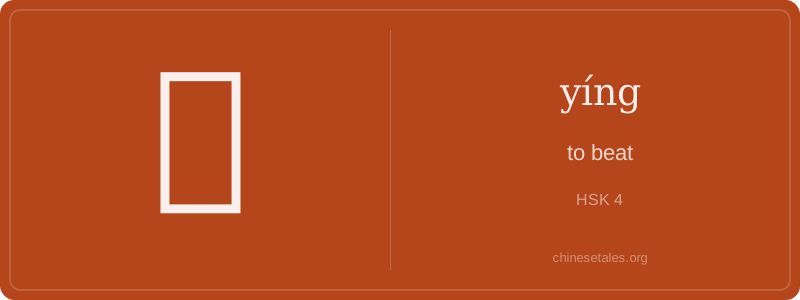
The earliest form of 赢 appears in Warring States bamboo slips — not as a single pictograph, but as a complex composite. Its structure reveals ancient logic: top-left 贝 (bèi, 'cowrie shell', symbolizing wealth/value), top-right 亡 (wáng, 'to lose' — but here acting phonetically), middle 月 (yuè, 'flesh/month', later stylized from 肉 ròu, indicating the body/effort), bottom 龟 (guī, 'turtle', a symbol of endurance and longevity — though this evolved into the modern + 凡 shape). Over centuries, these elements fused and simplified into today’s 17-stroke form, where every component whispers 'value + effort + endurance = victory'.
This layered origin shaped its classical usage: in the Guǎnzǐ, 赢 describes gaining strategic advantage through resourcefulness; in Tang poetry, it evokes triumph after arduous travel. The turtle element is especially telling — victory wasn’t flashy, but steady, resilient, and long-lasting. Even today, when Chinese say 他赢了人心 (Tā yíng le rén xīn — 'He won people’s hearts'), the 'turtle' echoes: true winning requires patience, integrity, and time — not just speed or force.
At first glance, 赢 (yíng) feels like a 'winner' character — and it is! But unlike English 'win', which is neutral or even casual ('Let’s win this game!'), 赢 carries subtle weight: it implies *earned victory* — through effort, strategy, or fairness. You don’t just 'win' a lottery with 赢 (that’s 中奖 zhòng jiǎng); you 赢 a match, a debate, or a business negotiation. It’s active, competitive, and often interpersonal.
Grammatically, 赢 is a transitive verb that *requires* an object — you must win *something*: 赢比赛 (yíng bǐsài), 赢时间 (yíng shíjiān), 赢信任 (yíng xìnrèn). Learners often omit the object ('I won!' → *Wǒ yíng le!*), but that sounds incomplete — like saying 'I conquered!' without saying what. Instead, say 我赢了这场比赛 (Wǒ yíng le zhè chǎng bǐsài) — the object anchors the meaning.
Culturally, 赢 reflects Confucian-tinged values: winning isn’t about domination, but about rightful superiority earned through merit. That’s why 赢 appears in idioms like 赢在起跑线 (yíng zài qǐpǎo xiàn — 'win at the starting line'), highlighting preparation over luck. A common mistake? Using 赢 for passive outcomes — e.g., 'She won the prize' should usually be 她获得了奖 (tā huòdé le jiǎng), not 她赢了奖. Prizes are *received*; victories are *achieved*.