赶
Character Story & Explanation
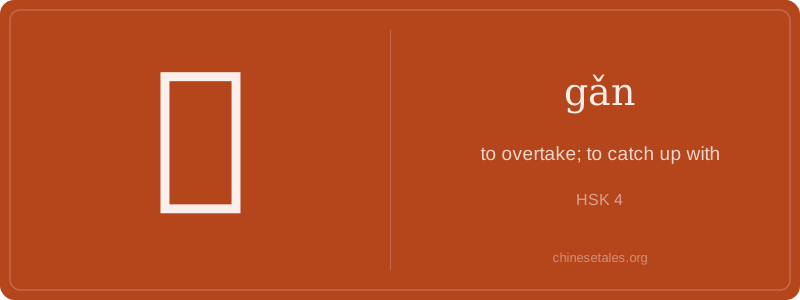
The earliest form of 赶 appears in seal script as a combination of 走 (zǒu, 'to walk/run') on the left—a radical showing a person with feet stepping forward—and 干 (gān, originally a spear or pole) on the right. In oracle bone inscriptions, this wasn’t just ‘walking’—it was *propelling forward with force*, like driving cattle with a stick. Over centuries, the ‘spear’ shape simplified into the modern 干, while the ‘walking’ radical evolved from a full figure with legs to today’s streamlined 走—10 strokes total, each one contributing to that sense of dynamic pursuit.
By the Han dynasty, 赶 solidified its meaning of ‘driving’ (livestock) and ‘chasing’ (prey or enemies), appearing in texts like the *Shuōwén Jiězì* as ‘to urge forward by striking’. Its semantic expansion—from physical pursuit to temporal urgency (‘hurry up!’) and social action (‘rush to help’)—mirrors China’s agrarian rhythms: farmers ‘gǎn’ seasonal deadlines, scholars ‘gǎn’ imperial exams, and families ‘gǎn’ festivals. The character’s visual logic remains intact: footwork + force = purposeful motion toward a moving target.
Think of 赶 (gǎn) as the Chinese equivalent of a sprinter leaning forward at the finish line—not just running, but *reaching*, *closing the gap*, and *snatching* what’s just ahead. Its core feeling isn’t passive ‘going’—it’s urgent, directional motion with intent: to overtake, to catch up, to chase down. Unlike English verbs like 'go' or 'run', 赶 always implies a target—someone or something you’re trying to match or surpass in speed, time, or position.
Grammatically, it’s wonderfully versatile: it can take direct objects ('赶火车' — catch a train), appear in serial verb constructions ('赶上去' — rush up and catch up), and even form resultative complements ('赶得上' — be able to catch up). A classic learner trap? Using 赶 when you mean 'to go' generically—e.g., saying *‘我赶学校’* instead of ‘我去学校’. That sounds like you’re chasing your school like a runaway bus! Remember: 赶 needs a goal, not just a destination.
Culturally, 赶 carries a quiet urgency tied to timeliness and social responsibility—think of parents rushing kids to piano lessons, workers sprinting to avoid missing a deadline, or villagers ‘赶集’ (going to the market) on its fixed day. It’s rarely frantic; it’s purposeful, communal, and slightly time-pressured—like the gentle nudge of a conductor tapping his baton to keep the orchestra in sync.