距
Character Story & Explanation
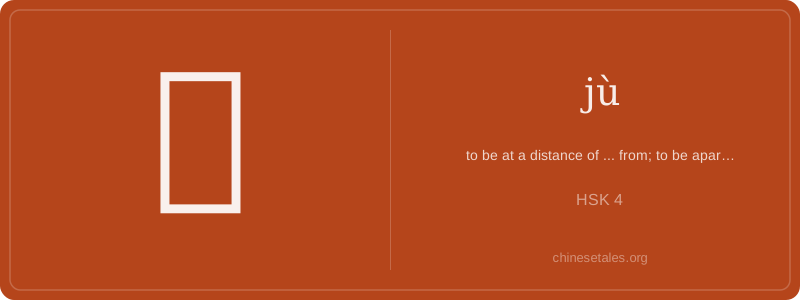
The earliest form of 距 appears in bronze inscriptions as a combination of 足 (foot) and 巨 (giant, large) — not as a pictograph of distance itself, but as a depiction of a foot stepping *with deliberate magnitude*, suggesting a measured stride or reach. Over time, the top element stabilized into 巨 (not ‘giant’ per se, but a phonetic component with connotations of scale and extension), while the bottom remained 足 (foot), anchoring the idea in bodily movement and spatial orientation. By the Han dynasty, the structure was standardized to its current 11-stroke form: 足 on the left, 巨 on the right — a visual metaphor for ‘foot-measuring-scale’.
This concrete origin evolved into abstract usage by the Warring States period. In the *Mozi*, 距 describes the calculated spacing between defensive towers; later, in Tang poetry, it appears in phrases like 距天不遥 (‘not far from heaven’), where distance becomes metaphysical. Crucially, 距 never meant ‘to separate’ actively — it always implied passive, observable separation: the gap *already there*, waiting to be measured. That quiet objectivity — no emotion, no intention, just space — is baked into every stroke.
At its heart, 距 isn’t just about physical distance — it’s about measured, relational space: the precise gap between two points, people, or ideas. Unlike generic words for 'far' (e.g., 远), 距 carries a subtle tone of objectivity and quantifiability, like a ruler laid across reality. You’ll almost always see it in structures like 距…有… (‘is … away from …’) or 距离 (its most common compound), where the emphasis is on calculable separation — think GPS coordinates, architectural blueprints, or social boundaries.
Grammatically, 距 rarely stands alone; it’s almost exclusively used as part of 距离 (jùlí, ‘distance’) or in formal/technical expressions like 距今 (jù jīn, ‘X years ago from now’). Learners often mistakenly use 距 as a verb like ‘to distance oneself’ — but that’s wrong! For intentional separation, you need 疏远 or 保持距离. Also, note: 距 is never used with measure words directly (no *距三米*); instead, it’s 距离三米 or 距…三米.
Culturally, this character reflects the Chinese value of calibrated relationships — not just ‘close’ or ‘far’, but *how far*, *from what*, and *in what context*. In classical texts, 距 appears in military treatises describing formation gaps, and today it subtly shapes how we talk about emotional proximity: saying 两人距离很远 can describe both subway stops and estranged siblings. A common mistake? Confusing it with 居 (jū, ‘to reside’) — same sound, totally different root and meaning!