躺
Character Story & Explanation
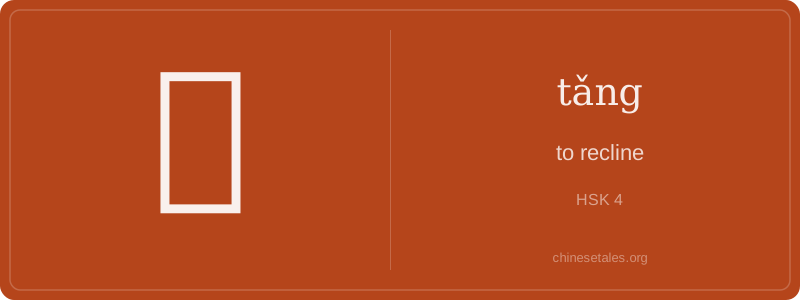
The earliest form of 躺 appears in seal script (c. 3rd century BCE), where it clearly combines 身 (shēn, ‘body’) on the left — drawn as a kneeling figure with arms and torso — and 尚 (shàng, ‘still, yet, above’) on the right, originally depicting a table or platform with a lid. Together, they visually narrated ‘a body placed upon a surface’ — not fallen, but *positioned*. Over centuries, the ‘body’ radical simplified into its modern crouching shape, and 尚 lost its lid-like top, evolving into today’s 15-stroke structure: a poised body leaning onto something elevated.
This semantic core held steady through classical texts — Mencius (Mengzi) uses 躺 in descriptions of proper reclining posture during mourning rituals, emphasizing dignity even in repose. By the Tang dynasty, poets like Bai Juyi wrote of lying beside bamboo groves to ‘cool the heart’, cementing 躺 as both physical act and aesthetic choice. Crucially, the character never meant ‘to fall’ or ‘to die’ — unlike English ‘lie’, it resists negative connotation. Its visual logic remains intact: the left side is your whole self (身), the right side is where you place yourself (尚 → ‘upon’). You don’t just happen to be horizontal — you *choose* the surface.
At its heart, 躺 (tǎng) isn’t just ‘to lie down’ — it’s the quiet, intentional surrender of upright posture. It carries a gentle weight: not collapse (like 倒 dǎo), not sleep (like 睡 shuì), but conscious reclining — on a sofa, in bed, even stretched out on grass. The character radiates physical ease and mental pause, often implying rest, recovery, or deliberate idleness (e.g., 躺平 tǎng píng — ‘lying flat’, a Gen Z metaphor for opting out of societal pressure).
Grammatically, 躺 is an intransitive verb that *requires* a location complement — you can’t just ‘lie’; you must 躺在沙发上 (tǎng zài shā fā shàng, ‘recline *on* the sofa’) or 躺在床上 (tǎng zài chuáng shàng, ‘recline *in* bed’). Learners often omit 在, producing ungrammatical sentences like ❌‘他躺沙发’ — a classic HSK 4 slip. Also, note: it’s never used for ‘lying’ as in deception (that’s 撒谎 sā huǎng); confusing these two is a hilarious but revealing error.
Culturally, 躺 appears in warm domestic scenes — think grandparents resting after lunch, a child recovering from fever, or someone scrolling on their phone while sprawled on the floor. Unlike the formal, upright connotations of 身 (its radical, meaning ‘body’), 躺 celebrates bodily autonomy and low-stakes stillness — a subtle counterpoint to China’s high-achievement culture. Its frequent pairing with 平 (píng, ‘flat’) in slang also shows how deeply this character has embedded itself into contemporary social commentary.