适
Character Story & Explanation
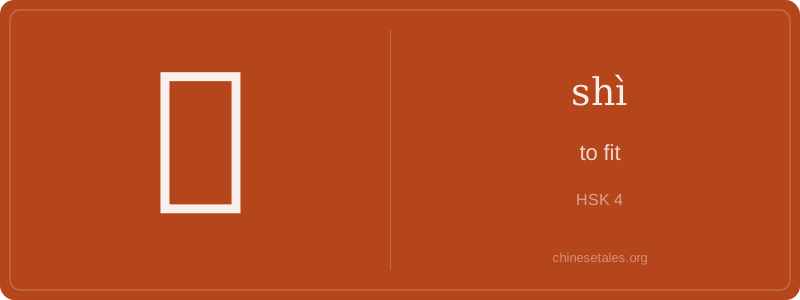
The earliest form of 适 appears in bronze inscriptions as a compound: left side was a simplified ‘shì’ (originally depicting a ritual vessel or ‘proper offering’), and right side was 辵 (chuò), the walking radical — later standardized as 辶. Over time, the left evolved into the modern ‘舌’-like component (though it’s *not* 舌!), while the right became the familiar ‘walking’ radical with three strokes under the ‘foot’. Crucially, the original shape conveyed movement *toward appropriateness* — not passive fitting, but purposeful arrival at the right place or state.
This dynamic origin shaped its meaning: in the *Zuo Zhuan*, 适 appears as ‘to go to’ (e.g., 适齐 — ‘went to Qi’), emphasizing intentional arrival. By Han dynasty texts, it broadened to ‘suitable’ — because arriving *where you belong* implies inherent fitness. The visual duality remains: the ‘walking’ radical (辶) hints at action and journey, while the top evokes discernment — together, they whisper: ‘fitting isn’t static; it’s a mindful step toward harmony.’
At its heart, 适 (shì) isn’t just ‘to fit’ like a key in a lock — it’s about *harmonious suitability*, the quiet satisfaction of something being *just right* for a person, place, or moment. Think less ‘this shirt fits my body’ and more ‘this job fits my temperament’ — it carries an ethical and aesthetic weight, echoing Confucian ideals where fitting in isn’t conformity, but alignment with virtue and context.
Grammatically, 适 is rarely used alone in modern speech; it shines in compounds and formal writing. You’ll see it as a verb (e.g., 适应 — ‘to adapt to’), an adjective (e.g., 适当 — ‘appropriate’), or even as a literary adverb meaning ‘just then’ (适逢其会). Learners often mistakenly use it like English ‘fit’ in casual sentences (‘This dress fits me’ → *×这个裙子适我*); instead, use 合身 or 穿得下 — 适 needs a relational, almost philosophical object: 适于环境 (suitable *for* the environment), not *for me*.
Culturally, 适 reflects China’s deep valuing of contextual harmony over absolute rules. A policy isn’t ‘right’ in the abstract — it must be 适宜 (shìyí, ‘suitable’) for local conditions. Misusing 适 as a standalone verb (like ‘I fit this role’) sounds stiff or archaic — it’s the difference between quoting Mencius and ordering lunch. Also, watch tone: shì (4th) is easy to mispronounce as shī (1st) — and ‘shī’ means ‘lose’, so ‘I shī this job’ would mean ‘I lost this job’!