邀
Character Story & Explanation
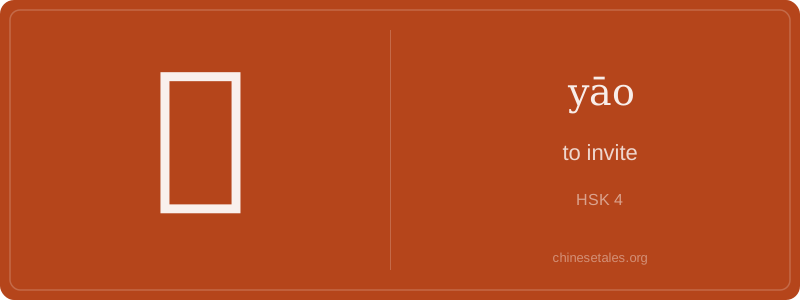
The earliest forms of 邀 appear in seal script, where it combined two key elements: the radical 辶 (chuò, 'walking') on the left — representing movement toward someone — and the phonetic component 尧 (yáo) on the right, which originally depicted a tall, dignified figure with a large headdress (like a legendary sage-ruler). Over centuries, 尧 simplified from a complex pictograph into today’s six-stroke form, while 辶 evolved from a full 'walking' glyph into its modern three-stroke 'walk radical' — always signaling motion or directionality.
This visual logic stayed true: to 邀 is literally 'to walk toward someone with noble intent'. In classical texts like the Book of Rites, 邀 appears in contexts of ceremonial hospitality — elders 'inviting' juniors to sit, scholars 'inviting' each other to compose poems. Its meaning never strayed far from that core idea of intentional, respectful outreach. Even today, the character’s shape whispers: *I move toward you — not to command, but to welcome.*
At its heart, 邀 (yāo) isn’t just ‘to invite’ — it’s the gentle but deliberate act of *reaching out and drawing someone in*, often with warmth, intention, or even a hint of persuasion. Unlike the neutral 招 (zhāo, 'to summon') or the formal 请 (qǐng, 'to request'), 邀 carries emotional texture: think birthday parties, poetry gatherings, or a friend saying, 'Come join us!' — it implies mutual goodwill and personal connection.
Grammatically, 邀 is almost always transitive and followed by a person (e.g., 邀请朋友) or an event (e.g., 邀请参加婚礼). It rarely stands alone — you’ll almost always see it as part of the compound 邀请 (yāoqǐng), especially in writing and formal speech. Learners sometimes mistakenly use it like an intransitive verb ('We are inviting' without an object), but Chinese requires clarity: *who* is invited? Also, avoid confusing it with 受邀 (shòu yāo, 'to be invited') — the passive form, which flips the subject entirely.
Culturally, 邀 reflects China’s emphasis on relational intentionality: an invitation isn’t just logistics — it’s face (miànzi), respect, and shared joy. A well-timed 邀 can strengthen guānxi (relationships); a careless one (e.g., inviting only some colleagues) can cause subtle embarrassment. And yes — you *can* invite someone to do something abstract: 邀请合作 (invite cooperation), 邀请思考 (invite reflection). That poetic flexibility is uniquely 邀.