Word Explanation
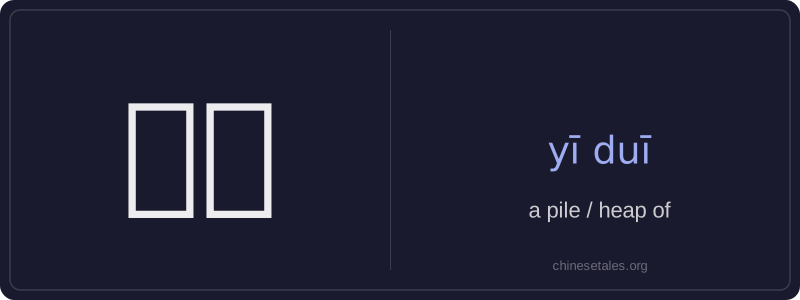
‘一堆’ (yī duī) literally combines the numeral ‘一’ (one) and the measure word ‘堆’, which means ‘pile’ or ‘heap’. Together, it functions as a quantifier phrase meaning ‘a pile of’ or ‘a heap of’, used before countable nouns—especially when referring to loosely grouped, uncountable, or irregularly shaped items. It often carries a casual or slightly informal tone, and may imply abundance, disorder, or informality.
This phrase is commonly used with tangible objects like trash, books, clothes, or food—but also appears idiomatically with abstract nouns (e.g., 一堆问题 ‘a pile of problems’) or even animals when describing them collectively in an informal, non-technical way (e.g., 一堆小猫 ‘a pile of kittens’). Unlike precise measure words like ‘只’ (zhī) for individual animals, ‘一堆’ emphasizes quantity and visual clustering rather than count or taxonomy.
Example Sentences
Related Words
国语
‘Guó yǔ’ literally means 'national language'—
无论谁
‘无论谁’ (wú lùn shéi) is a pronoun meaning
外语
‘外语’ literally means ‘outside language’ —
面条
‘面条’ (miàn tiáo) literally means ‘flour str
不对
不对 (bù duì) literally combines 不 (bù), meani
认为
‘认为’ (rèn wéi) is a transitive verb meaning
认同
‘认同’ (tóng rèn) is a verb meaning ‘to ident
中学
'Zhōngxué' literally combines 'zhōng' (middle)