Word Explanation
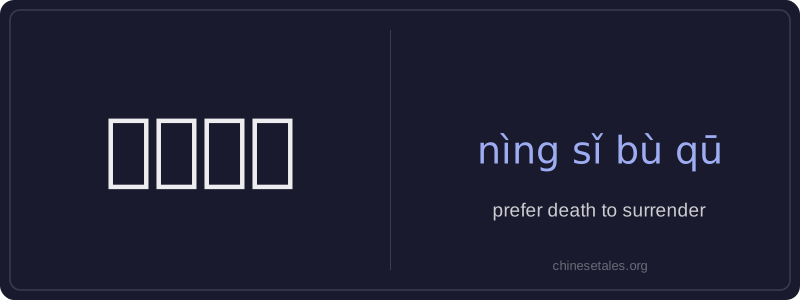
‘宁死不屈’ is a four-character idiom expressing unwavering moral integrity and steadfast resistance in the face of coercion or oppression. Literally, it means ‘rather die than yield’: 宁 (nìng) conveys ‘would rather’, 死 (sǐ) means ‘death’, 不 (bù) is the negation ‘not’, and 屈 (qū) means ‘to bend’, ‘to submit’, or ‘to surrender’. Together, the phrase emphasizes an absolute refusal to compromise one’s principles—even at the cost of life.
This idiom carries strong historical and ethical weight in Chinese culture, often associated with loyal ministers, revolutionaries, or heroes who chose martyrdom over betrayal or humiliation. It is commonly used in formal writing, historical narratives, speeches about patriotism or integrity, and moral education—not in casual daily conversation. While grammatically flexible, it functions most naturally as a noun (e.g., ‘his 宁死不屈 inspired generations’) or attributive adjective (e.g., ‘a 宁死不屈 spirit’).
Example Sentences
Related Words
国语
‘Guó yǔ’ literally means 'national language'—
无论谁
‘无论谁’ (wú lùn shéi) is a pronoun meaning
外语
‘外语’ literally means ‘outside language’ —
面条
‘面条’ (miàn tiáo) literally means ‘flour str
不对
不对 (bù duì) literally combines 不 (bù), meani
认为
‘认为’ (rèn wéi) is a transitive verb meaning
认同
‘认同’ (tóng rèn) is a verb meaning ‘to ident
中学
'Zhōngxué' literally combines 'zhōng' (middle)