Word Explanation
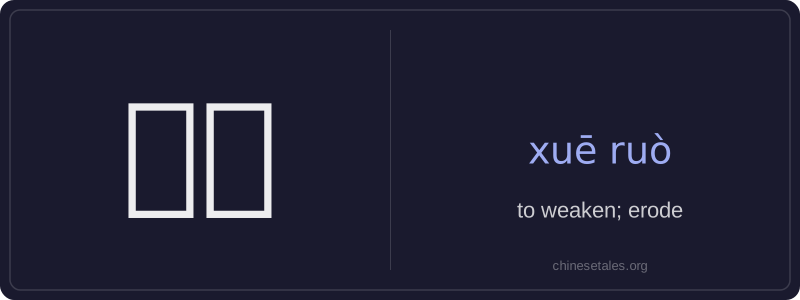
'削弱' is a compound verb meaning 'to weaken' or 'to erode'—often implying a gradual, measurable reduction in strength, power, influence, or effectiveness. The first character 削 (xuē) literally means 'to pare down' or 'to cut away', like shaving wood; the second character 弱 (ruò) means 'weak' or 'feeble'. Together, they convey the idea of actively diminishing something’s robustness—not just making it temporarily less effective, but reducing its inherent capacity. It's commonly used in formal and semi-formal contexts: politics, health, economics, and science.
This word emphasizes agency and process: someone or something causes the weakening, and the effect is often sustained or cumulative. It rarely describes sudden collapse (use 崩溃 for that) or natural decay without cause (use 衰退). It frequently appears with objects like 'authority', 'immune system', 'effectiveness', 'resistance', or 'influence', and often pairs with complements indicating degree ('了', '得厉害') or agents ('被...所削弱').
Example Sentences
Related Words
国语
‘Guó yǔ’ literally means 'national language'—
无论谁
‘无论谁’ (wú lùn shéi) is a pronoun meaning
外语
‘外语’ literally means ‘outside language’ —
面条
‘面条’ (miàn tiáo) literally means ‘flour str
不对
不对 (bù duì) literally combines 不 (bù), meani
认为
‘认为’ (rèn wéi) is a transitive verb meaning
认同
‘认同’ (tóng rèn) is a verb meaning ‘to ident
中学
'Zhōngxué' literally combines 'zhōng' (middle)