Word Explanation
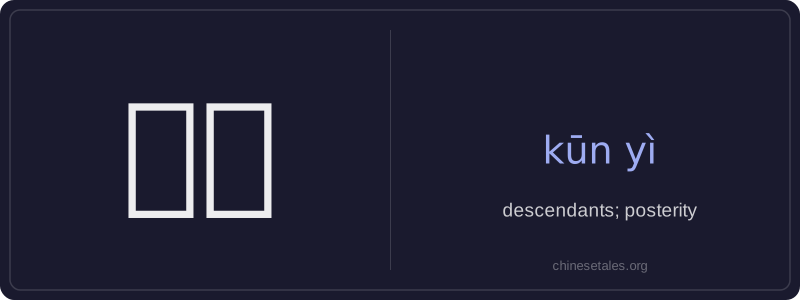
‘昆裔’ is a formal, literary noun meaning ‘descendants’ or ‘posterity’, often used in classical or ceremonial contexts to refer to future generations of a family, lineage, or even a species. The character 昆 (kūn) originally means ‘many’ or ‘numerous’, and historically appears in words like 昆虫 (kūnchóng, ‘insect’) — referencing the vast number of insect species; 裔 (yì) means ‘offspring’, ‘descendant’, or ‘remote descendant’, literally evoking the idea of ‘distant branches of a family tree’. Together, 昆裔 conveys the sense of ‘numerous descendants’ — emphasizing both continuity and abundance across generations.
This term is rarely used in everyday speech but appears frequently in historical texts, ancestral inscriptions, genealogical records, and formal speeches honoring heritage. It carries a dignified, respectful tone and is often paired with words like ‘绵延’ (miányán, ‘to continue unbroken’) or ‘永续’ (yǒngxù, ‘perpetual succession’). While it can technically apply to human lineages, its association with 昆虫 gives it subtle resonance in biological or ecological discourse about species propagation — hence its inclusion under the ‘Animals’ topic.
Example Sentences
Related Words
国语
‘Guó yǔ’ literally means 'national language'—
无论谁
‘无论谁’ (wú lùn shéi) is a pronoun meaning
外语
‘外语’ literally means ‘outside language’ —
面条
‘面条’ (miàn tiáo) literally means ‘flour str
不对
不对 (bù duì) literally combines 不 (bù), meani
认为
‘认为’ (rèn wéi) is a transitive verb meaning
认同
‘认同’ (tóng rèn) is a verb meaning ‘to ident
违规
违规 (wéi guī) literally means 'to violate rules