Word Explanation
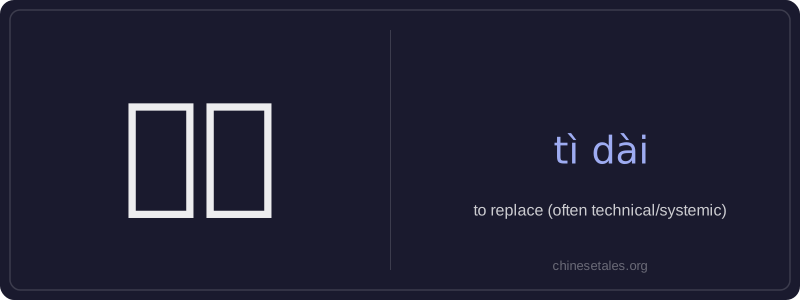
替代 means 'to replace' or 'to substitute', emphasizing a functional or systemic replacement—often in technical, medical, or institutional contexts. The character 替 (tì) means 'to stand in for' or 'to act on behalf of', while 代 (dài) means 'to take the place of' or 'generation'; together, they reinforce the idea of one thing assuming the role or function of another, usually with intention and equivalence in purpose.
This word is commonly used when discussing alternatives in formal settings—such as medical treatments (e.g., a drug replacing another), mechanical parts, software functions, or policy measures. It implies that the replacement is deliberate, often authorized or evaluated, and maintains essential functionality. Unlike the more casual 换 (huàn), 替代 carries a tone of precision, continuity, and sometimes necessity—like when a failing system requires an engineered substitute.
Example Sentences
Related Words
国语
‘Guó yǔ’ literally means 'national language'—
无论谁
‘无论谁’ (wú lùn shéi) is a pronoun meaning
外语
‘外语’ literally means ‘outside language’ —
面条
‘面条’ (miàn tiáo) literally means ‘flour str
不对
不对 (bù duì) literally combines 不 (bù), meani
认为
‘认为’ (rèn wéi) is a transitive verb meaning
认同
‘认同’ (tóng rèn) is a verb meaning ‘to ident
违规
违规 (wéi guī) literally means 'to violate rules