Word Explanation
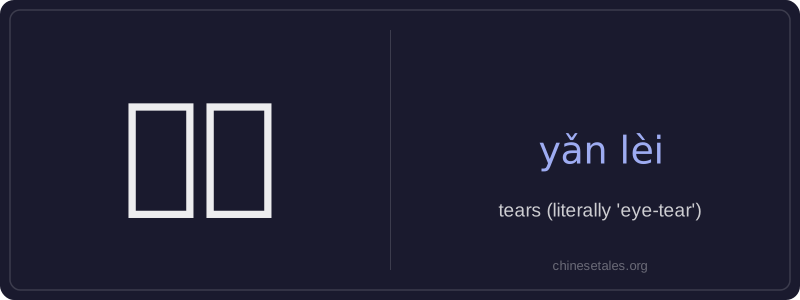
‘Yǎn lèi’ literally means ‘eye-tear’ and refers to tears—the liquid that flows from the eyes, especially in response to strong emotions like sadness, joy, pain, or relief. The character 眼 (yǎn) means ‘eye’, and 泪 (lèi) means ‘tear’; together, they form a compound noun that is the standard, neutral term for tears in modern Mandarin. Unlike some poetic or literary alternatives, 眼泪 is widely used in everyday speech and writing, and it’s always countable (e.g., 一滴眼泪 ‘one drop of tears’) or used collectively (e.g., 眼泪流下来 ‘tears flow down’).
This word carries emotional weight but isn’t inherently positive or negative—it depends on context. For instance, tears of laughter, gratitude, or grief all use 眼泪. It’s often paired with verbs like 流 (liú, ‘to flow’), 掉 (diào, ‘to fall/drop’), or 擦 (cā, ‘to wipe’). Note that 泪 alone can appear in formal or literary contexts (e.g., 泪水), but 眼泪 is the most common, natural choice for learners.
Example Sentences
Related Words
国语
‘Guó yǔ’ literally means 'national language'—
无论谁
‘无论谁’ (wú lùn shéi) is a pronoun meaning
外语
‘外语’ literally means ‘outside language’ —
面条
‘面条’ (miàn tiáo) literally means ‘flour str
认同
‘认同’ (tóng rèn) is a verb meaning ‘to ident
不对
不对 (bù duì) literally combines 不 (bù), meani
认为
‘认为’ (rèn wéi) is a transitive verb meaning
违规
违规 (wéi guī) literally means 'to violate rules