Word Explanation
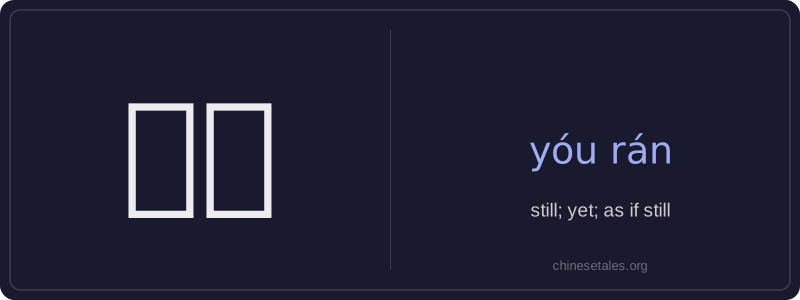
‘犹然’ is an adverb meaning ‘still,’ ‘yet,’ or ‘as if still,’ conveying a sense of continuity—especially of a feeling, state, or impression that persists despite time passing or circumstances changing. The character 犹 (yóu) means ‘still,’ ‘yet,’ or ‘as if,’ often carrying a nuance of lingering resemblance or unexpected persistence; 然 (rán) functions as a suffix meaning ‘thus’ or ‘in this way,’ reinforcing the adverbial quality. Together, they form a literary and slightly formal expression commonly found in written Chinese, essays, poetry, or reflective speech—not everyday casual conversation.
It frequently modifies verbs or adjectives to highlight enduring emotional states (e.g., 犹然感动 — ‘still deeply moved’) or perceptual impressions (e.g., 犹然如昨 — ‘still vividly like yesterday’). While grammatically similar to 更然 or 依然, 犹然 carries a more poetic, introspective tone—often evoking nostalgia, quiet awe, or unresolved sentiment. It’s rarely used in spoken Mandarin unless for rhetorical or stylistic effect.
Example Sentences
Related Words
国语
‘Guó yǔ’ literally means 'national language'—
无论谁
‘无论谁’ (wú lùn shéi) is a pronoun meaning
外语
‘外语’ literally means ‘outside language’ —
面条
‘面条’ (miàn tiáo) literally means ‘flour str
认同
‘认同’ (tóng rèn) is a verb meaning ‘to ident
不对
不对 (bù duì) literally combines 不 (bù), meani
认为
‘认为’ (rèn wéi) is a transitive verb meaning
违规
违规 (wéi guī) literally means 'to violate rules