Word Explanation
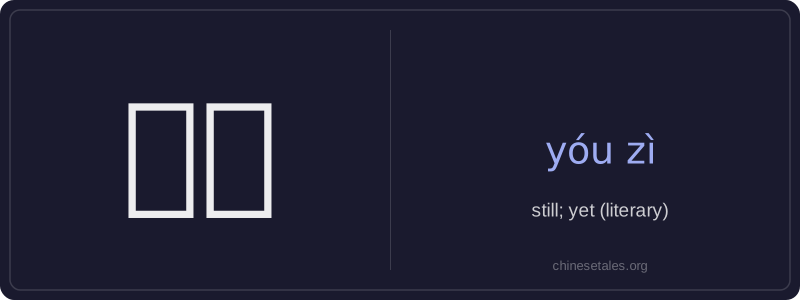
‘犹自’ is a literary adverb meaning ‘still’ or ‘yet’, conveying that a state or action continues despite expectations to the contrary—often implying persistence, lingering emotion, or unexpected endurance. The character 犹 (yóu) means ‘still’ or ‘as if’, carrying a sense of continuity or resemblance; 自 (zì) here reinforces the idea of ‘by itself’ or ‘on its own’, intensifying the sense of unchanging, inherent continuation. Together, they form a compact, elegant expression common in classical poetry, formal writing, and modern literary prose—but rarely used in everyday speech.
This term frequently appears in contexts involving emotion (e.g., sorrow or longing), natural phenomena (e.g., rain persisting), or abstract states (e.g., hope remaining). It often follows a verb or adjective and precedes the predicate, typically in subject–verb–犹自–complement structures. Because of its elevated register, using ‘犹自’ in casual conversation may sound unnatural or overly ornate—learners should reserve it for written or rhetorical contexts.
Example Sentences
Related Words
国语
‘Guó yǔ’ literally means 'national language'—
无论谁
‘无论谁’ (wú lùn shéi) is a pronoun meaning
外语
‘外语’ literally means ‘outside language’ —
面条
‘面条’ (miàn tiáo) literally means ‘flour str
认同
‘认同’ (tóng rèn) is a verb meaning ‘to ident
不对
不对 (bù duì) literally combines 不 (bù), meani
认为
‘认为’ (rèn wéi) is a transitive verb meaning
违规
违规 (wéi guī) literally means 'to violate rules