Word Explanation
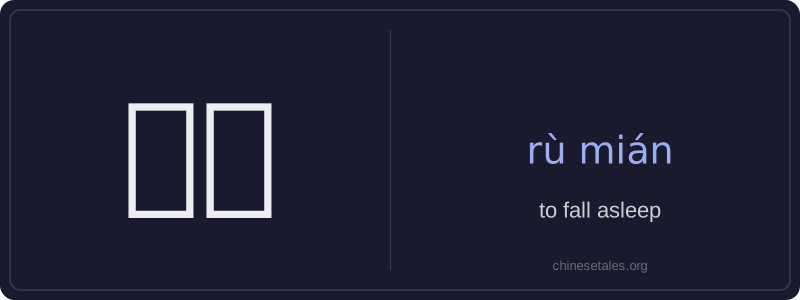
‘入眠’ is a formal or literary verb meaning ‘to fall asleep’ — the moment when consciousness fades and sleep begins. The first character 入 (rù) means ‘to enter’, and 眠 (mián) means ‘sleep’; together, they literally convey ‘entering sleep’. Unlike colloquial expressions like ‘睡觉’ (shuì jiào), which simply means ‘to sleep’, ‘入眠’ emphasizes the *transition* into sleep — often used to describe difficulty falling asleep, sleep onset, or conditions affecting sleep initiation.
This term appears frequently in health contexts (e.g., insomnia discussions), medical reports, mindfulness or sleep hygiene advice, and literary descriptions of quiet evenings or bedtime routines. It is rarely used in casual speech among friends but common in written Chinese, news articles about sleep science, and clinical settings. Because it’s a two-character compound verb, it typically follows subjects and time/duration phrases (e.g., ‘难以入眠’, ‘很快入眠’) and does not take aspect particles like 了 or 过 as readily as more colloquial verbs.
Example Sentences
Related Words
国语
‘Guó yǔ’ literally means 'national language'—
无论谁
‘无论谁’ (wú lùn shéi) is a pronoun meaning
外语
‘外语’ literally means ‘outside language’ —
面条
‘面条’ (miàn tiáo) literally means ‘flour str
认同
‘认同’ (tóng rèn) is a verb meaning ‘to ident
不对
不对 (bù duì) literally combines 不 (bù), meani
认为
‘认为’ (rèn wéi) is a transitive verb meaning
违规
违规 (wéi guī) literally means 'to violate rules