Word Explanation
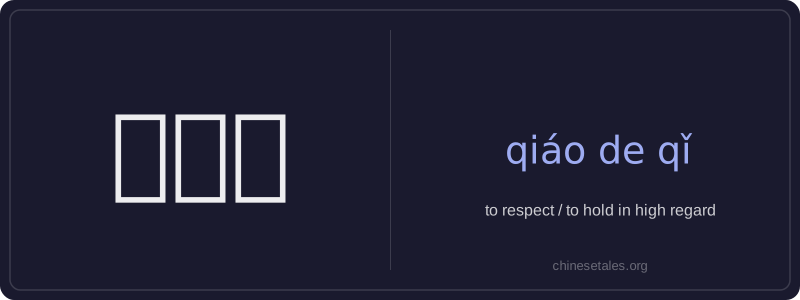
'瞧得起' is a verb phrase meaning 'to respect' or 'to hold in high regard,' often implying that someone considers another person worthy, capable, or admirable — especially despite potential obstacles like social status, background, or appearance. The character 瞧 literally means 'to look,' but here it functions idiomatically; 得 marks the potential complement, and 起 indicates upward movement or attainment — together, the phrase conveys 'being able to look up to (someone).'
This expression is commonly used in spoken and informal written Chinese, frequently appearing in contexts involving interpersonal evaluation, humility, gratitude, or self-reflection. It’s often paired with negation (瞧不起) to mean 'to look down on,' making the positive form carry a warm, appreciative nuance. It typically takes a person or group as its object and appears after the subject — e.g., '他瞧得起你' ('He respects you'). It reflects values of modesty and recognition of others’ worth.
Example Sentences
Related Words
国语
‘Guó yǔ’ literally means 'national language'—
无论谁
‘无论谁’ (wú lùn shéi) is a pronoun meaning
外语
‘外语’ literally means ‘outside language’ —
面条
‘面条’ (miàn tiáo) literally means ‘flour str
认同
‘认同’ (tóng rèn) is a verb meaning ‘to ident
不对
不对 (bù duì) literally combines 不 (bù), meani
认为
‘认为’ (rèn wéi) is a transitive verb meaning
违规
违规 (wéi guī) literally means 'to violate rules