Word Explanation
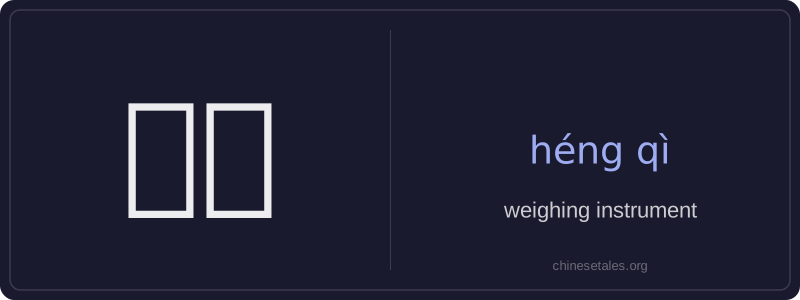
‘衡器’ literally means ‘balance instrument’: ‘衡’ (héng) originally referred to a beam balance — a device with a central pivot and two pans — and carries the core meaning of ‘measuring weight’ or ‘equilibrium’; ‘器’ (qì) means ‘tool’ or ‘instrument’. Together, 衡器 is a formal, technical term for any device used to measure mass or weight, such as scales, balances, digital weighing machines, or platform scales. It’s commonly used in scientific, commercial, and regulatory contexts — for example, in metrology, food markets, pharmacies, or logistics.
Unlike everyday words like 秤 (chèng), which refers specifically to traditional or common scales, 衡器 is broader and more institutional. It appears in official documents, calibration standards, and quality-control settings. While not part of casual speech, learners may encounter it in news reports about market inspections or in descriptions of laboratory equipment. The term emphasizes precision and function over form — whether mechanical or electronic, if it measures weight accurately, it qualifies as a 衡器.
Example Sentences
Related Words
国语
‘Guó yǔ’ literally means 'national language'—
无论谁
‘无论谁’ (wú lùn shéi) is a pronoun meaning
外语
‘外语’ literally means ‘outside language’ —
不对
不对 (bù duì) literally combines 不 (bù), meani
违规
违规 (wéi guī) literally means 'to violate rules
亲笔
‘亲笔’ literally means ‘one’s own hand’—comb
我的
我的 (wǒ de) is a possessive pronoun meaning 'my'
面条
‘面条’ (miàn tiáo) literally means ‘flour str