Word Explanation
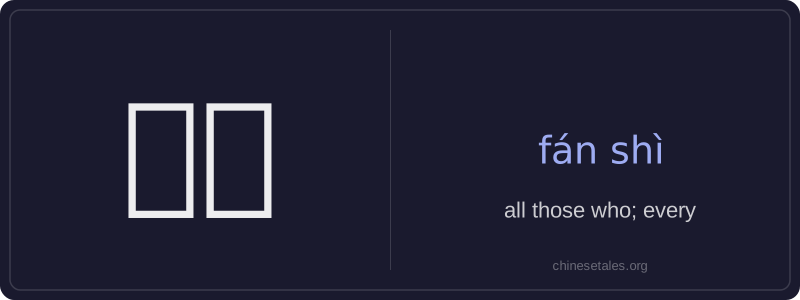
凡是 is a conjunction meaning 'all those who', 'every (person/thing that)', or 'anyone/anything that'. It introduces a universal condition and is always followed by a clause or noun phrase, emphasizing inclusivity without exception. The character 凡 means 'all', 'every', or 'ordinary', while 是 functions here as a grammatical pivot — not 'is' but a marker of definiteness and scope, reinforcing the universality of what follows. Together, 凡是 signals that what comes next applies to every single instance in the stated category.
This word is commonly used in formal writing, instructions, rules, and generalizations — for example, in policies ('凡是员工必须 attend...'), scientific statements, or moral principles. It’s rarely used in casual speech and almost never stands alone; it must be paired with a subsequent clause. Learners often mistakenly treat it like a noun or pronoun, but it functions strictly as a subordinating conjunction introducing conditional universality.
Example Sentences
Related Words
国语
‘Guó yǔ’ literally means 'national language'—
无论谁
‘无论谁’ (wú lùn shéi) is a pronoun meaning
外语
‘外语’ literally means ‘outside language’ —
不对
不对 (bù duì) literally combines 不 (bù), meani
我的
我的 (wǒ de) is a possessive pronoun meaning 'my'
违规
违规 (wéi guī) literally means 'to violate rules
亲笔
‘亲笔’ literally means ‘one’s own hand’—comb
面条
‘面条’ (miàn tiáo) literally means ‘flour str