Word Explanation
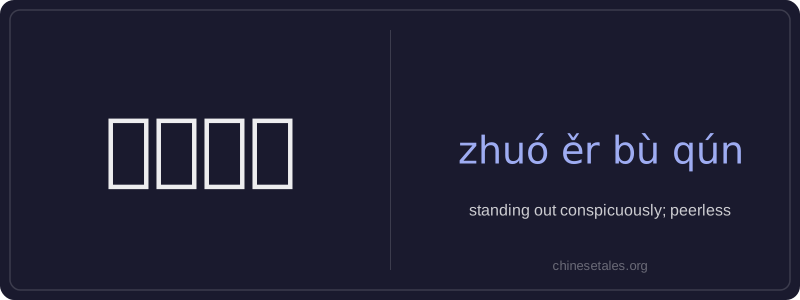
‘卓尔不群’ is a classical Chinese idiom describing someone or something that stands out remarkably from others — not merely different, but exceptionally outstanding in talent, character, or achievement. Literally, 卓 (zhuó) means 'outstanding' or 'eminent'; 尔 (ěr) is an archaic pronoun meaning 'thus' or 'in this way', here functioning as a grammatical linker; 不 (bù) is the negation 'not'; and 群 (qún) means 'group' or 'crowd'. Together, the phrase conveys the idea of being so superior that one cannot be grouped with ordinary people.
This idiom is highly literary and formal, often used in written contexts such as essays, biographies, award citations, or speeches praising excellence. It carries strong positive connotations of moral integrity, intellectual distinction, or artistic mastery — not just uniqueness, but admirable, rare excellence. It’s rarely used in casual conversation and never for trivial differences (e.g., clothing style). Instead, it evokes admiration for principled, exceptional individuals who rise above mediocrity through virtue or ability.
Example Sentences
Related Words
国语
‘Guó yǔ’ literally means 'national language'—
无论谁
‘无论谁’ (wú lùn shéi) is a pronoun meaning
外语
‘外语’ literally means ‘outside language’ —
不对
不对 (bù duì) literally combines 不 (bù), meani
我的
我的 (wǒ de) is a possessive pronoun meaning 'my'
违规
违规 (wéi guī) literally means 'to violate rules
亲笔
‘亲笔’ literally means ‘one’s own hand’—comb
面条
‘面条’ (miàn tiáo) literally means ‘flour str