Word Explanation
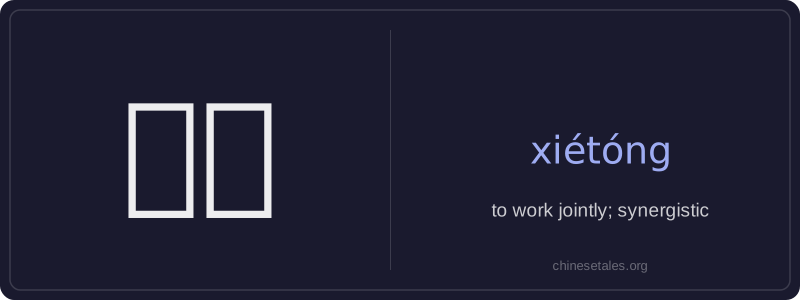
'协同' (xiétóng) is a verb meaning 'to work jointly' or 'to collaborate synergistically.' It combines 协 (xié), which conveys coordination, harmony, or assistance, and 同 (tóng), meaning 'together' or 'same.' Together, they emphasize purposeful, coordinated action among two or more parties toward a shared goal — not just parallel effort, but integrated, mutually reinforcing cooperation.
This word appears frequently in professional, educational, and technological contexts: team projects, cross-departmental initiatives, or AI-human collaboration. It carries a formal, positive tone and implies efficiency and alignment. While it can occasionally function as a noun (e.g., 协同效应 'synergistic effect'), its primary use is verbal, often followed by an object (e.g., 协同工作, 协同完成任务) or used in the ba- or bei-construction. It’s less common in casual daily speech than simpler terms like 合作 or 一起做.
Example Sentences
Related Words
国语
‘Guó yǔ’ literally means 'national language'—
无论谁
‘无论谁’ (wú lùn shéi) is a pronoun meaning
外语
‘外语’ literally means ‘outside language’ —
不对
不对 (bù duì) literally combines 不 (bù), meani
我的
我的 (wǒ de) is a possessive pronoun meaning 'my'
违规
违规 (wéi guī) literally means 'to violate rules
亲笔
‘亲笔’ literally means ‘one’s own hand’—comb
面条
‘面条’ (miàn tiáo) literally means ‘flour str