Word Explanation
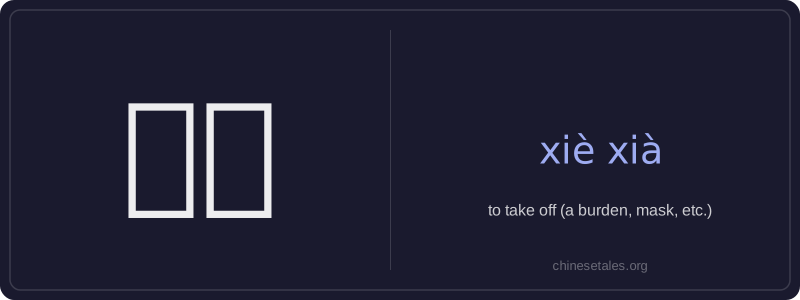
卸下 literally means 'to unload downward'—'卸' (xiè) means 'to unload, remove, or take off', and '下' (xià) indicates downward direction or completion. Together, 卸下 emphasizes the act of removing something weighty, burdensome, or artificial—not just physically, but metaphorically. It’s commonly used for shedding emotional loads (e.g., stress, pretense, guilt), social roles (e.g., authority, responsibility), or symbolic coverings (e.g., a mask, facade, or uniform).
This verb is formal yet natural in both spoken and written Chinese, especially in reflective, literary, or psychologically nuanced contexts. It carries a connotation of relief or liberation after removal, implying that what was taken off had been weighing on the subject. Unlike simple verbs like 脱 (tuō, 'to take off clothing'), 卸下 rarely refers to physical garments; instead, it evokes mental, emotional, or social release—like setting down an invisible load you’ve carried too long.
Example Sentences
Related Words
国语
‘Guó yǔ’ literally means 'national language'—
无论谁
‘无论谁’ (wú lùn shéi) is a pronoun meaning
外语
‘外语’ literally means ‘outside language’ —
不对
不对 (bù duì) literally combines 不 (bù), meani
我的
我的 (wǒ de) is a possessive pronoun meaning 'my'
违规
违规 (wéi guī) literally means 'to violate rules
亲笔
‘亲笔’ literally means ‘one’s own hand’—comb
面条
‘面条’ (miàn tiáo) literally means ‘flour str