Word Explanation
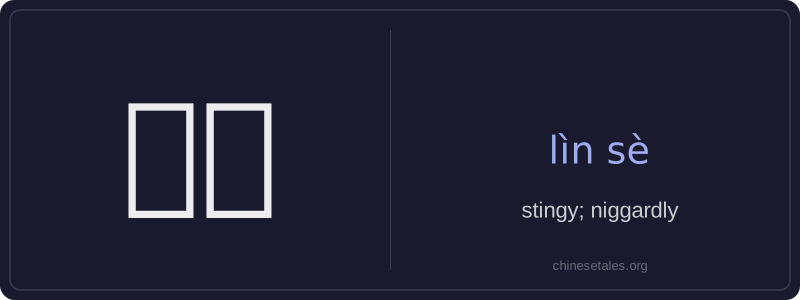
吝啬 is an adjective meaning 'stingy' or 'niggardly'—describing someone who is excessively unwilling to spend money or share resources, often to the point of self-deprivation or social disapproval. The character 吝 (lìn) originally meant 'to withhold' or 'to grudge', while 啬 (sè) conveys 'frugality' or 'scarcity', historically linked to careful grain storage. Together, they intensify the sense of unreasonable, tight-fisted behavior—not mere prudence, but a negative, socially judged attitude toward giving or spending.
This word carries clear disapproval and is commonly used in moral evaluations, storytelling, or everyday criticism. It appears in both spoken and written Chinese, though it’s slightly more formal than colloquial alternatives like 小气. 吝啬 can modify nouns directly (e.g., 吝啬的人) or serve as a predicate (e.g., 他很吝啬). It’s rarely used neutrally or positively—unlike 啬 alone, which in classical contexts could imply admirable thrift.
Example Sentences
Related Words
国语
‘Guó yǔ’ literally means 'national language'—
无论谁
‘无论谁’ (wú lùn shéi) is a pronoun meaning
外语
‘外语’ literally means ‘outside language’ —
不对
不对 (bù duì) literally combines 不 (bù), meani
我的
我的 (wǒ de) is a possessive pronoun meaning 'my'
违规
违规 (wéi guī) literally means 'to violate rules
亲笔
‘亲笔’ literally means ‘one’s own hand’—comb
面条
‘面条’ (miàn tiáo) literally means ‘flour str