Word Explanation
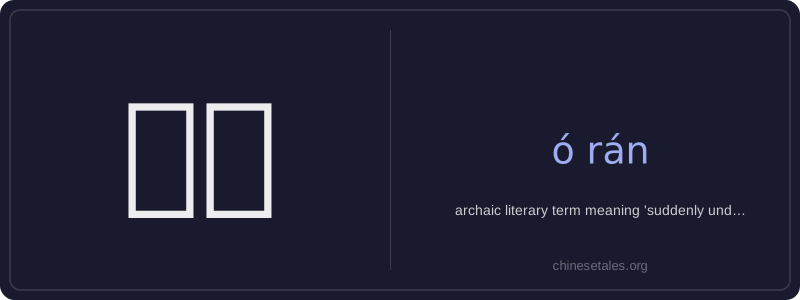
‘哦然’ is an archaic literary noun meaning ‘a sudden flash of understanding’ or ‘an instantaneous realization’. Though composed of two characters—‘哦’ (a particle expressing sudden awareness, like ‘oh!’) and ‘然’ (meaning ‘thus’, ‘so’, or ‘in this manner’)—together they form a fixed, classical expression that denotes the moment cognition clicks into place, often with emotional resonance. It appears almost exclusively in pre-modern poetry, essays, and philosophical texts, not in spoken or modern written Chinese.
This term evokes a quiet, inward epiphany—not loud or dramatic, but profound and personal—similar to the English ‘aha moment’, though more refined and contemplative. Because it carries classical elegance and gravity, it’s unsuitable for casual conversation, technical writing, or instructional contexts. Learners should recognize it when reading classical literature but avoid using it actively unless composing highly stylized, traditional-style prose or poetry.
Example Sentences
Related Words
国语
‘Guó yǔ’ literally means 'national language'—
无论谁
‘无论谁’ (wú lùn shéi) is a pronoun meaning
外语
‘外语’ literally means ‘outside language’ —
不对
不对 (bù duì) literally combines 不 (bù), meani
我的
我的 (wǒ de) is a possessive pronoun meaning 'my'
违规
违规 (wéi guī) literally means 'to violate rules
亲笔
‘亲笔’ literally means ‘one’s own hand’—comb
面条
‘面条’ (miàn tiáo) literally means ‘flour str